扣
Character Story & Explanation
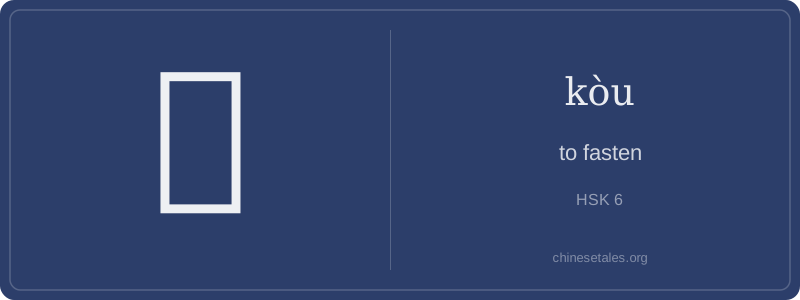
The earliest form of 扣 appears in Warring States bamboo texts as a hand radical (扌) gripping a curved shape resembling a bow or bent arm — possibly depicting a finger hooking or pulling a loop, like fastening a belt clasp or closing a lid with a latch. Over time, the right side simplified from 口 (a pictograph of a mouth-shaped aperture or container) plus a dot or stroke indicating closure, evolving into 央 — though this component now functions phonetically, not semantically. The six strokes we write today — 横、竖钩、提、竖、横折、横 — crystallized during the Han dynasty clerical script, balancing speed and clarity.
By the Tang dynasty, 扣 expanded beyond physical fastening: in legal texts, it meant 'to detain'; in poetry, like Li Bai’s lines describing moonlight ‘扣窗而入’ (kòu chuāng ér rù, 'tapping gently at the window'), it carried a quiet, rhythmic insistence. The character’s visual logic endures: the hand (扌) acts upon something that must be secured — whether fabric, fate, or funds. Even today, when officials ‘扣押证据’ (kòu yā zhèng jù, 'seize evidence'), they echo ancient scribes sealing bamboo slips with lacquer and string.
At its heart, 扣 (kòu) is about *connection with intention* — not just fastening, but securing something deliberately: a button, a lid, a debt, even a question. Its core feeling is tactile and precise: think fingers pressing down, clicking into place, or locking something shut. Unlike generic ‘to close’ (关), 扣 implies active engagement — you’re using your hand to make something fit, hold, or seal.
Grammatically, it’s wonderfully versatile. As a verb, it governs objects directly: 扣帽子 (kòu mào zi, 'to pin a label on someone'), 扣工资 (kòu gōng zī, 'to deduct wages'). It also appears in resultative complements like 扣紧 (kòu jǐn, 'fasten tightly') and passive constructions like 被扣留 (bèi kòu liú, 'be detained'). Learners often overgeneralize it as 'to lock' — but 扣 doesn’t mean 'lock' in the sense of a padlock (that’s 锁); instead, it evokes mechanical or social 'clipping': a button snaps, a charge is docked, an accusation sticks.
Culturally, 扣 carries subtle weight — especially in idioms like 扣人心弦 (kòu rén xīn xián, 'to tug at the heartstrings'), where it suggests emotional resonance so strong it feels physically gripping. A classic mistake? Using 扣 for 'to tie' (like shoelaces) — that’s 系 (xì). Also, 扣 is never used for digital 'clicking' (that’s 点 or 单击); its action is always physical, consequential, and slightly formal.