扛
Character Story & Explanation
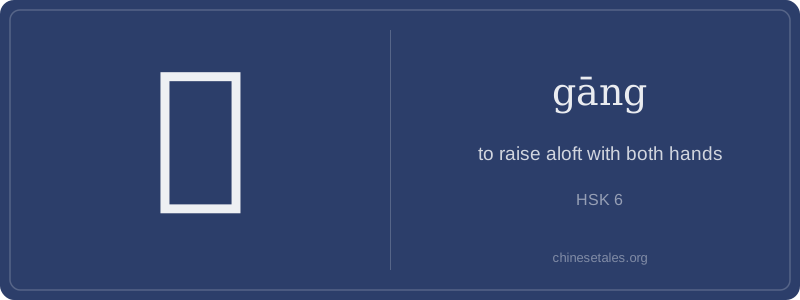
The earliest form of 扛 appears in bronze inscriptions as a hand (手) gripping a vertical pole or beam — not just holding, but actively raising it upward. Over time, the hand simplified into the 扌 radical (three-stroke hand gesture), while the right side evolved from a pictograph of a straight, upright object (like a staff or beam) into the modern 工 (gōng), which originally meant ‘work’ or ‘tool’, reinforcing the idea of purposeful, labor-intensive lifting. Crucially, the six strokes aren’t arbitrary: the three horizontal strokes of 工 suggest stability and structure — the very thing you must *create* when lifting something heavy overhead.
This visual logic cemented its meaning early on: in the Zuo Zhuan, 扛 describes warriors lifting siege ladders; by the Tang dynasty, poets used it for lifting banners high in victory parades. Even today, its shape whispers ‘two hands + structural support = upward triumph’. Interestingly, classical texts never used it for passive transport — it’s always an act of assertion, resilience, or duty. That’s why modern usage extends so naturally to abstract burdens: 扛住压力 isn’t about enduring quietly — it’s about *holding pressure aloft*, visibly, defiantly, like a torch.
Think of 扛 (gāng) as Chinese weightlifting — not the slow, controlled lift of a barbell, but the sudden, heroic heave of a fallen comrade onto your shoulders during a battlefield retreat. It’s visceral, two-handed, and urgent: you’re not just carrying — you’re *raising aloft* with full bodily commitment. That ‘aloft’ nuance is key: 扛 implies vertical elevation (shoulder-height or higher), often against resistance — like hoisting a heavy log, lifting a ceremonial banner, or even metaphorically ‘bearing’ immense pressure (e.g., 扛起责任). Unlike generic ‘carry’ verbs like 拿 or 带, 扛 demands physical presence and upward force.
Grammatically, 扛 is almost always transitive and action-oriented. You’ll see it in imperative commands (‘扛起来!’ — ‘Lift it up!’), perfective aspect with 了 (他扛起了箱子), or in vivid compound verbs like 扛不住 (‘can’t bear it’ — literally ‘can’t hold it aloft’). Learners often mistakenly use it for everyday carrying (e.g., ‘I carry my bag to school’) — but that’s 背, 提, or 拿. 扛 belongs to moments of effort, crisis, or ceremony.
Culturally, 扛 carries subtle heroism — it appears in revolutionary slogans (‘扛起革命大旗’) and martial arts manuals describing how to lift a fallen master. The alternate reading káng (e.g., in 北京话) softens it slightly — more colloquial, sometimes humorous — but gāng remains the standard literary and formal pronunciation. Watch out: mispronouncing it as káng in formal writing can sound unpolished; using it where 拎 or 背 fits better makes your Chinese sound oddly theatrical.