抗
Character Story & Explanation
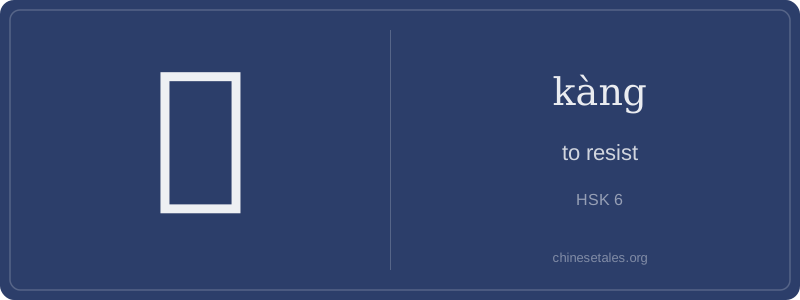
The earliest form of 抗 appears in Warring States bamboo texts as a hand (扌) gripping a long, upright object — possibly a pole or beam — with a horizontal stroke above suggesting compression or resistance. Over time, the ‘upright object’ simplified into the 口-like shape (actually a stylized ‘gān’ 干 component), while the hand radical remained firmly on the left. By the Han dynasty clerical script, the strokes had stabilized: three for the hand (扌), then four more forming the right side — not a mouth (口), but a visual echo of ‘dryness’ (干) and ‘strength’ (亢), merging into a compact glyph that looks like a hand *lifting against downward pressure*.
This physical image seeded its semantic evolution: from ‘holding up a beam’ in construction texts (like the *Rites of Zhou*) to ‘withstanding pressure’ in medical classics (e.g., 抗邪 — resisting pathogenic factors), then to moral-political defiance in Ming-Qing novels and modern history. The *Analects* doesn’t use 抗, but later Confucian commentators applied it to ‘resisting unjust authority’ — turning a carpenter’s term into a philosophical verb. Its visual tension — hand + rigid upright — still mirrors how Mandarin uses it today: deliberate, effortful, and never passive.
At its core, 抗 (kàng) isn’t just ‘to resist’ — it’s *pushing back against force*, often with grit, defiance, or structural tension. Think of a bamboo pole bracing against a collapsing roof, or a diplomat refusing an ultimatum: the character carries physical weight and moral urgency. It’s transitive and almost always requires an object (e.g., 抗议, 抗拒, 抗压), unlike English ‘resist’, which can stand alone. You wouldn’t say ‘He resist’ in Chinese — you *must* say 抗什么: 抗压 (resist pressure), 抗议 (protest *against* something), 抗菌 (fight *bacteria*).
Grammatically, it rarely appears alone as a verb in modern speech — instead, it thrives in compound verbs and nouns. As a prefix, it signals active opposition: 抗日 (resist Japan → anti-Japanese resistance), 抗癌 (anti-cancer). Learners often mistakenly use it like English ‘resist’ in abstract contexts (e.g., ‘I resist temptation’) — but Chinese prefers 忍受, 克制, or 避免 there. 抗 implies *organized, directed counterforce*, not inner restraint.
Culturally, 抗 is loaded with historical resonance: 抗日战争 (the War of Resistance Against Japan) anchors it in national memory, giving the character solemn, collective weight. Also watch tone: kàng is fourth tone — flat and decisive — matching its unyielding meaning. Confusing it with kāng (as in 康) or kǎng (a rare variant) breaks both sound and sense. And crucially: no passive voice. 抗 is always *someone or something pushing back — never being pushed.*