拄
Character Story & Explanation
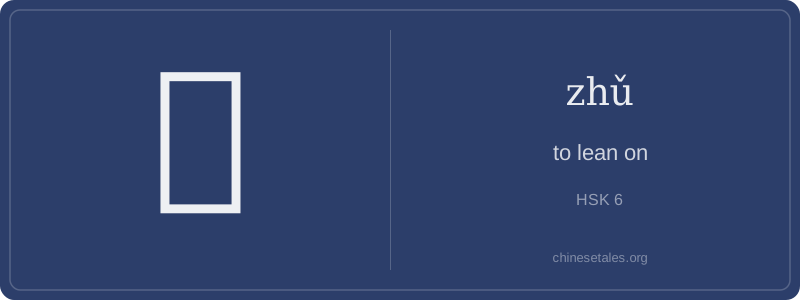
The earliest form of 拄 appears in seal script (c. 3rd c. BCE), where the left side was 扌 (hand radical), and the right was 主 (zhǔ) — originally a pictograph of a ritual flame burning steadily on an altar, symbolizing presence, authority, and centrality. Over time, 主 simplified to its modern shape, but retained its core idea: ‘that which holds focus or bears weight’. The hand radical emphasized agency — not passive support, but *active, intentional bracing*. By the Han dynasty, the character had stabilized into its current 8-stroke form: three strokes for 扌 (lift, press, anchor), then five for 主 (dot, horizontal, vertical, dot, horizontal — like fingers gripping a solid post).
This visual logic shaped its semantic evolution: from literal ‘bracing with hand on a staff’ in Warring States texts (e.g., ‘拄杖而行’ — walking leaning on a staff), to figurative uses by the Tang dynasty, where poets used 拄 to express leaning on memory, principle, or loyalty. In the *Book of Rites*, 拄 appears in descriptions of proper elder care — not as pity, but as respectful co-stance: two bodies sharing balance. The character never lost its tactile precision: every stroke insists on contact, pressure, and groundedness.
At its heart, 拄 (zhǔ) isn’t just ‘to lean on’ — it’s the quiet, embodied acknowledgment of dependence: a cane against an aging parent’s palm, a hand braced on a windowsill during grief, or even metaphorically leaning on tradition in uncertain times. Unlike generic verbs like ‘support’ (支持), 拄 carries physical immediacy and vulnerability — you can’t 拄 air; there must be a tangible point of contact, usually with weight bearing down. It’s intimate, slightly fragile, and deeply human.
Grammatically, 拄 is almost always transitive and requires a clear object — you 拄 *something*: a cane (拄拐), a wall (拄墙), a table (拄着桌子). Note the crucial particle 着 (zhe): 拄着 signals ongoing, sustained contact (‘leaning *on*’, not just ‘to lean’), making it distinct from momentary actions like 推 (push) or 拉 (pull). Learners often omit 着 and produce ungrammatical sentences like *他拄拐 — missing both the required object and aspect marker.
Culturally, 拄 reflects Confucian values around interdependence: leaning isn’t weakness but relational honesty — elders leaning on children, children leaning on ancestral wisdom. In classical poetry, 拄 appears in melancholic contexts (e.g., Du Fu’s lines about leaning on railings while contemplating exile), embedding physical posture with emotional gravity. A common mistake? Confusing it with 扯 (chě, ‘to pull’) — same radical, but wildly different sound and meaning. Remember: 拄 is *weight-bearing stillness*, not motion.