拖
Character Story & Explanation
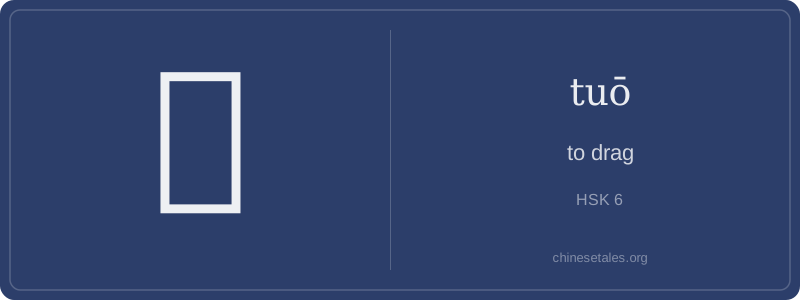
The earliest form of 拖 appears in seal script as 扌 + 施 — but that ‘施’ wasn’t the modern word for ‘to implement’. It was a phonetic-semantic compound: the left side 扌 (hand radical) showed action, while the right side 施 originally depicted a hand holding a ceremonial banner being *drawn slowly across space*. Bronze inscriptions show simplified strokes emphasizing horizontal tension — two parallel lines (later becoming the ‘horizontal stroke + hook’ in the lower right) representing the path of resistance, and the top strokes evolving into the ‘hand’ and ‘pressing-down’ gesture. By the Han dynasty, 施 was replaced by 咄 (duō), a sound-alike character suggesting forceful exhalation — as if grunting while hauling weight.
This evolution mirrors how meaning deepened: from literal dragging (e.g., in the *Zuo Zhuan*, where soldiers ‘dragged chariots through mud’) to metaphorical burden (Tang poetry uses 拖累 — ‘drag down, burden’ — for familial obligations). The visual ‘hook’ in the lower right — now written as 乚 — once resembled a trailing rope, and still evokes something left behind, uncooperative, or lingering too long — making it perfect for procrastination (拖延) and bureaucratic delay.
At its heart, 拖 (tuō) isn’t just ‘to drag’ — it’s the feeling of resistance: something heavy, reluctant, or stubbornly unwilling to move *with you*. Think of dragging a suitcase with a broken wheel, or pulling a toddler away from the candy aisle. That tactile friction is baked into the character — it’s not smooth motion like 推 (push) or 拉 (pull), but effortful, horizontal, and often inefficient. You’ll hear it in verbs like 拖地 (tuō dì, 'to mop floors') — where the mop head drags across wet tile — or 拖延 (tuō yán, 'to procrastinate'), where time itself feels sticky and hard to pull forward.
Grammatically, 拖 is versatile: it can be transitive (拖行李 — 'drag luggage'), used in resultative compounds (拖垮 — 'drag down until collapse'), or even as a causative verb in spoken Mandarin (他拖我后腿 — 'He’s dragging me down'). A classic learner trap? Overusing 拖 for ‘delay’ — while 拖延 works perfectly, saying *我拖了会议* sounds unnatural; native speakers say 我让会议推迟了 or use 拖延 explicitly. Also, note: 拖 never implies lifting — if you’re hoisting a box, it’s 抬 (tái), not 拖.
Culturally, 拖 carries subtle judgment. To 拖后腿 ('drag someone’s leg') is a vivid idiom meaning to hinder progress — rooted in martial imagery of tripping comrades. And in bureaucratic contexts, 拖着不办 ('drag without handling') signals systemic inertia, not personal laziness. Learners sometimes confuse it with 托 (tuō, 'to hold up'), but remember: 扌 + 咄 (a sound hinting at forceful expulsion) = *pulling against resistance*, not gentle support.