拘
Character Story & Explanation
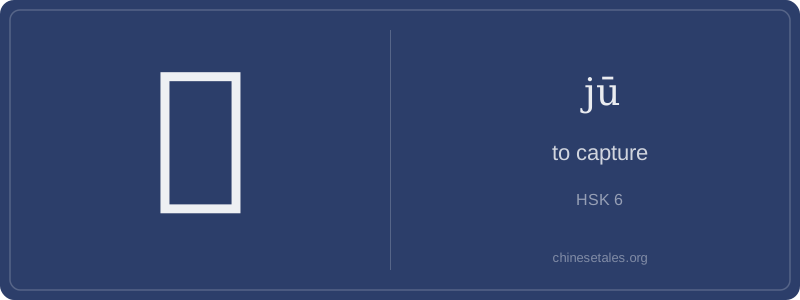
The earliest form of 拘 appears in late Warring States bamboo slips: left side was 扌 (hand radical), right side was 句 — not the modern simplified 句, but an ancient pictograph resembling a curved hook or a bent arm gripping something tightly. In bronze inscriptions, 句 often depicted a coiled rope or a restraining noose — visually echoing how a hand could seize and hold fast. Over centuries, the right-hand component standardized into today’s 句 (jù/jū), while the hand radical remained clear and assertive — eight strokes total, all purposeful: three for the hand, five for the act of encircling control.
This visual logic shaped its meaning from the start: in the *Zuo Zhuan*, 拘 appears in contexts like '拘其人以质' ('seize his person as hostage'), emphasizing binding authority, not mere grabbing. By the Tang dynasty, it became entrenched in legal terminology — distinguishing official detention from private coercion. Interestingly, its sound jū also echoes 句 (‘sentence’, ‘clause’), subtly linking legal restraint to linguistic precision: to 拘 someone is to place them precisely within the bounds of law, like fitting a word into the correct grammatical slot.
Imagine a police officer in Beijing’s Haidian District swiftly grabbing a suspect’s wrist — not with brute force, but with precise, controlled restraint. That moment — the decisive grip, the physical containment, the legal authority behind it — is the essence of 拘 (jū). It’s not just ‘to capture’ like a net flung over prey; it’s *official, lawful seizure*: arrest, detention, or formal custody. This character carries institutional weight — you don’t 拘 a runaway cat; you 拘 a suspect after evidence review.
Grammatically, 拘 almost always appears in compound verbs: 拘留 (jū liú, 'to detain'), 拘捕 (jū bǔ, 'to arrest'), or passively as 被拘 (bèi jū, 'was arrested'). It rarely stands alone — unlike 抓 (zhuā, 'to grab') which is colloquial and physical, 拘 is bureaucratic, papered, and procedural. Learners often mistakenly use it for casual capture ('I’ll 拘 that bird!'), but that’s a red flag — native speakers would cringe and say 抓 or 捕 (bǔ) instead.
Culturally, 拘 evokes the tension between state power and individual liberty — think of its frequent appearance in news reports, legal documents, or historical dramas about imperial censors. A common mistake? Confusing it with 居 (jū, 'to reside') due to identical pronunciation — but while 居 suggests stillness and home, 拘 implies constraint and motion stopped. Remember: 扌 (hand radical) + 句 (a bent shape, like a closed jaw or hooked arm) = hands imposing a bend on freedom.