拙
Character Story & Explanation
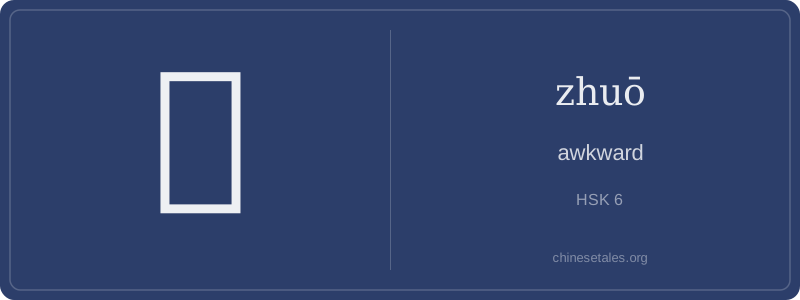
The earliest form of 拙 appears in Warring States bamboo texts — not as a pictograph, but as a phonosemantic compound. Its left side 扌 (hand radical) signals action or physical effort; its right side 出 (chū, ‘to go out’) was originally borrowed for sound, but visually suggests ‘something emerging awkwardly’ — like a hand pushing forth with hesitation. Over time, 出 simplified into the modern 4-stroke right component (彐 + 丨), losing its literal ‘exit’ meaning but keeping the sense of unrefined emergence. Stroke order reinforces this: first the hand (3 strokes), then the hesitant ‘push-out’ (5 strokes) — a visual metaphor for effort without fluency.
By the Han dynasty, 拙 had shifted from neutral ‘unskilled’ to virtuous ‘unadorned’ — echoing Daoist ideals in texts like the Zhuangzi, where ‘the most skillful is the one who appears clumsy’ (大巧若拙). This paradox became central: Confucian scholars used 拙 to signal moral integrity over rhetorical polish; poets praised ‘拙趣’ (zhuōqù, ‘the charm of rustic simplicity’) as superior to artificial elegance. Even today, calling your essay 拙作 isn’t false modesty — it’s invoking a 2,000-year-old aesthetic that values authenticity over polish.
Think of 拙 (zhuō) as Chinese ‘awkward’ with a twist — not the cringe-worthy fumbling of a sitcom character, but the humble, self-deprecating awkwardness of a master calligrapher signing a painting with ‘my clumsy brushwork’ (拙作). It’s less about inability and more about deliberate modesty: in Classical Chinese, calling your own work 拙 is like a Renaissance painter signing ‘this unworthy hand’ — it’s cultural etiquette disguised as self-criticism.
Grammatically, 拙 rarely stands alone. You’ll almost never say ‘他很拙’ (He is very awkward) — that sounds unnatural. Instead, it appears in fixed compounds (拙见, 拙作, 拙荆) or as an adjective before nouns, often in formal or literary contexts. Unlike colloquial words like 笨 (bèn, ‘stupid’) or 傻 (shǎ, ‘silly’), 拙 carries zero insult — using it to describe someone else without irony is dangerously rude; it’s reserved for *yourself*, your writing, your art, or your wife (in the archaic term 拙荆).
Learners often misapply 拙 as a general synonym for ‘clumsy’, then shock native speakers by saying ‘我的手很拙’ (My hands are very awkward) — which sounds like you’re quoting a Ming-dynasty scholar addressing the emperor. The nuance? 拙 is performative humility, not descriptive reality. Its power lies in what it *withholds*: competence, confidence, even intention — all politely veiled behind eight strokes of quiet deference.