拽
Character Story & Explanation
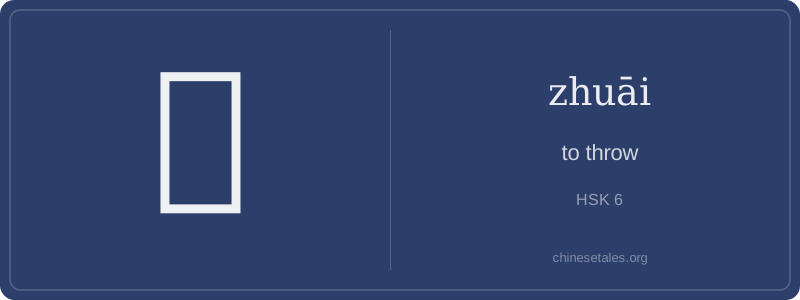
The earliest form of 拽 appears in seal script as a hand radical (扌) combined with 帅 (shuài), which originally depicted a banner or standard held aloft — symbolizing command and decisive movement. Over time, 帅 simplified visually into the top-right component (‘the flag’ became two diagonal strokes + a horizontal), while the hand radical stabilized as 扌 on the left. By the Song dynasty, the modern 9-stroke structure was fixed: three strokes for 扌 (a flick, a press, a lift), then six more forming a compact, angular upper half — mirroring the abrupt, downward-yank motion of the verb itself.
Classically, 拽 was rare in literary texts; its strength lived in folk speech and regional opera, where actors would '拽' props or costumes to punctuate drama. The Kangxi Dictionary (1716) lists it under 'forceful pulling', citing vernacular novels like Water Margin, where heroes '拽断铁链' (zhuāi duàn tiě liàn — 'yanked apart iron chains') — not with brute strength alone, but with defiant, kinetic will. Visually, the tight, slightly unbalanced composition — the hand radical leaning left, the upper part tilting right — evokes exactly that moment of torque before release.
At first glance, 拽 (zhuāi) seems like a simple 'to throw' — but it’s anything but neutral. In spoken Mandarin, especially northern dialects and informal registers, it carries a rough, physical, almost visceral energy: think hurling something with contempt, frustration, or sudden force — a crumpled paper ball into the trash, your phone across the room after a bad call, or even someone’s arm in a heated argument. It’s not elegant like 投 (tóu) or precise like 扔 (rēng); it’s emphatic, sometimes rude, and always bodily.
Grammatically, 拽 is nearly always transitive and action-oriented — it needs an object, and often appears in colloquial imperatives or past-tense narratives: '拽过来!' (zhuāi guò lái! — 'Yank it over!') or '他一把拽住她手腕' (tā yī bǎ zhuāi zhù tā shǒu wàn — 'He grabbed her wrist in one motion'). Unlike 抓 (zhuā) or 拉 (lā), 拽 implies a sharp, jerking motion — a tug that breaks inertia. Learners mistakenly use it for gentle pulling; that’s where 拉 shines.
Culturally, 拽 reflects how Chinese values physical immediacy in emotional expression — not just *what* you do, but *how* you do it matters. Its alternate pronunciations zhuǎi (slangy, 'cool/cocky') and zhuài (dialectal, 'to drag') show how one character morphs across registers — a reminder that tone and context are inseparable from meaning. Overusing 拽 in formal writing? That’s like shouting in a library: technically correct, but socially jarring.