挎
Character Story & Explanation
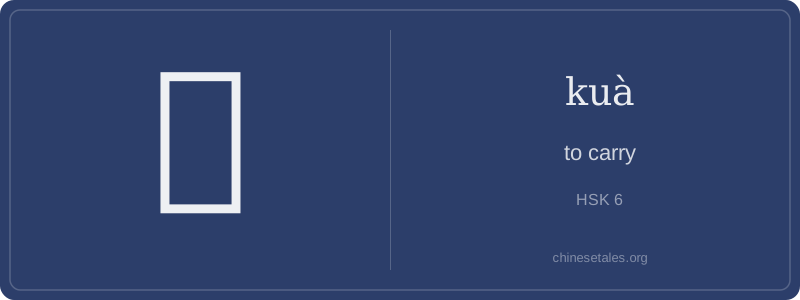
The earliest form of 挎 appears in seal script (c. 3rd century BCE), where it fused two key elements: the radical 扌 (shǒu, 'hand') on the left — representing manual action — and 口 (kǒu, 'mouth') on the right, which here isn’t about speech but functions phonetically and visually as a rounded, open shape suggesting *encirclement* or *hooking*. Over centuries, 口 simplified and rotated, and the middle stroke of the right side evolved into the distinctive curved hook-like stroke (㇆) — mirroring the physical arc of an arm looping around a strap or handle. By regular script, the nine strokes crystallized into a compact, slightly tilted structure: three hand-radical strokes, then six forming a tight, embracing right half.
This visual embrace became semantic reality: by the Tang dynasty, 挎 was used in poetry to describe warriors ‘hooking’ sword belts or courtesans ‘slung’ silk sashes — always implying controlled, graceful, body-integrated support. In the Ming novel Jin Ping Mei, a servant is described 挎着香炉 (kuà zhe xiāng lú, 'carrying an incense burner') — not lifting it, but cradling its base against her forearm while walking, preserving its balance and dignity. The character never meant 'to lift' or 'to drag'; from oracle bone roots onward, it encoded the elegant physics of *suspended weight anchored by the arm’s curve*.
Think of 挎 (kuà) as Chinese’s version of 'hooking your arm through a strap' — not just carrying, but carrying *with purposeful, casual physical engagement*. Unlike generic verbs like 拿 (ná, 'to hold') or 带 (dài, 'to bring'), 挎 implies the object is slung diagonally across the body: a shopping bag on the forearm, a tote over the shoulder, a backpack strap caught mid-swing. It’s the verb you’d use for someone breezily strolling down a Beijing hutong with groceries hooked on their elbow — not clutched, not dragged, but *carried in motion*.
Grammatically, 挎 is almost always transitive and requires a concrete, graspable object — you can’t ‘kuà’ an idea or a feeling. It frequently appears in serial verb constructions: '挎着包走路' (kuà zhe bāo zǒu lù, 'walking while carrying a bag'). Learners often mistakenly use it for hands-free carrying (e.g., holding a box with both hands), but that’s 托 (tuō) or 抱 (bào); 挎 demands that signature diagonal arm-hook — like hanging a strap on your bent elbow. Also, it rarely takes aspect particles like 了 or 过 unless emphasizing a completed shift in posture ('她刚挎上包就听见电话响了').
Culturally, 挎 carries subtle gendered and generational texture: older women in China are often described 挎着菜篮子 (kuà zhe cài lán zi, 'carrying a vegetable basket'), evoking warmth and domestic rhythm; younger urbanites might 挎着单肩包 (kuà zhe dān jiān bāo, 'slung a crossbody bag'), signaling relaxed confidence. Mistake it for 跨 (kuà, 'to stride over')? You’ll accidentally say someone ‘strides over their purse’ — a hilariously impossible image that instantly reveals the error.