挖
Character Story & Explanation
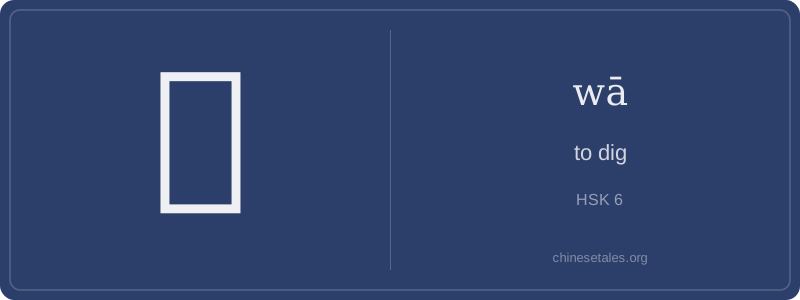
The earliest form of 挖 appears not in oracle bones (where digging actions were rare), but in seal script around 500 BCE — a clear fusion of 扌 (hand radical) and 穴 (xué, ‘cave’ or ‘hole’), which itself evolved from a pictograph of a person entering a sheltered cavity. In the modern character, the left side 扌 signals manual action; the right side 匼 (a simplified descendant of 穴) retains the ‘enclosed space’ idea — but notice the top stroke bends down like a shovel blade pressing into ground, and the bottom ‘八’-like shape suggests soil being parted. Every stroke feels kinetic: the three horizontal strokes in the hand radical mimic gripping, while the diagonal stroke in 匽 slashes downward — pure digging motion.
This visual logic shaped its semantic evolution. In the *Zuo Zhuan* (c. 4th c. BCE), 挖 appears in military contexts describing trench-digging to fortify cities — literal earth-moving. By the Tang dynasty, poets like Du Fu used it metaphorically: ‘挖心’ (wā xīn, ‘dig the heart’) expressed unbearable emotional excavation. The character never lost its visceral charge: even today, 挖出真相 (‘dig out the truth’) carries the weight of laborious, sometimes painful discovery — as if truth must be wrested from stubborn ground, not simply found.
At its core, 挖 (wā) isn’t just ‘to dig’ in the dirt — it’s a verb of *extraction with effort*, carrying physical strain, intentionality, and often, revelation. Think of archaeologists brushing away dust to uncover a jade dragon, or a manager 'digging' through spreadsheets for hidden inefficiencies. Unlike generic verbs like 做 (do) or 搞 (handle), 挖 implies penetrating a surface or layer to reach something buried — whether soil, data, truth, or even talent.
Grammatically, 挖 is transitive and almost always takes an object: you 挖坑 (dig a pit), 挖渠道 (dig a channel), or 挖掘潜力 (tap potential). It rarely stands alone — saying ‘I dig’ without specifying *what* sounds incomplete, like saying ‘I excavate’ in English without naming the site. Learners often mistakenly use it intransitively (e.g., *他挖了*), but native speakers expect *他挖了一个洞* or *他一直在挖井*. Also note: it’s almost never used for gentle scooping (that’s 捞 or 舀); 挖 implies resistance — pushing against earth, bureaucracy, or silence.
Culturally, 挖 has taken on rich metaphorical life. In business, 挖墙脚 (wā qiáng jiǎo, ‘dig the corner of the wall’) means poaching employees — visualizing undermining someone’s foundation. And in literature, 挖苦 (wā kǔ, ‘dig bitterness’) doesn’t mean ‘dig up bitterness’ literally; it’s a fixed compound meaning ‘to ridicule sarcastically’, where ‘dig’ evokes sharp, probing verbal thrusts. A common learner trap? Confusing 挖 with 掘 (jué) — both mean ‘excavate’, but 掘 is formal, literary, and rarely used in speech, while 挖 is vivid, colloquial, and action-packed.