挽
Character Story & Explanation
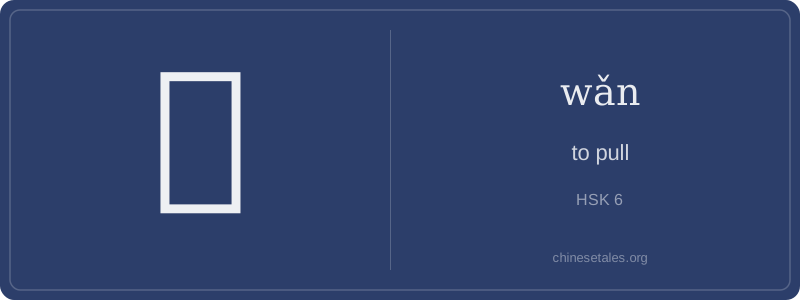
The earliest form of 挽 appears in bronze inscriptions as a hand (扌) gripping a rope-like curve, sometimes with a knot or loop at the end — unmistakably depicting a person straining to pull something heavy or recalcitrant. Over centuries, the rope simplified into the right-hand component 免 (miǎn), which originally depicted a man with a headless silhouette (a pictograph for ‘to avoid’ or ‘to remove’), but here was borrowed purely for sound and shape. By the seal script era, the hand radical stabilized on the left, while 免 lost its head-like detail and became a clean, angular 7-stroke unit — merging visual clarity with phonetic function. The final stroke count settled at 10: 3 for 扌 + 7 for 免.
This evolution mirrors a profound semantic shift: from literal, muscular pulling (like hauling a cart) to metaphorical ‘pulling back from loss’ — saving, retaining, or preserving. In the Book of Rites (Lǐjì), 挽 appears in descriptions of funeral processions, where mourners ‘pull’ the hearse — an act that evolved into the modern sense of ‘retrieving what’s slipping away’. Even today, the shape whispers its origin: your left hand (扌) grips the rope (the curved strokes of 免), and you lean back — not just moving an object, but anchoring meaning itself against entropy.
At its heart, 挽 (wǎn) isn’t just ‘to pull’ — it’s about *resisting separation*. Think of pulling a friend back from the edge, hauling a sinking boat ashore, or tugging a stubborn door shut: this is effort applied against loss, departure, or collapse. That emotional gravity makes it far more charged than neutral verbs like 拉 (lā) or 拖 (tuō). In classical and modern usage, it almost always implies urgency, care, or moral weight — you don’t ‘wǎn’ a chair; you ‘wǎn’ a life, a reputation, or a fading tradition.
Grammatically, 挽 is rarely used alone in speech — it thrives in compound verbs and formal writing. You’ll see it as the first character in set phrases like 挽救 (wǎnjiù, 'to rescue') or 挽留 (wǎnliú, 'to detain/entreat to stay'), where it contributes the core idea of ‘pulling back from irreversible loss’. Learners often mistakenly use it transitively without an object ('He wǎn the situation') — but in Chinese, it demands context: 挽回面子 (wǎnhuí miànzi, 'to save face'), not just 挽面子. It’s also nearly absent in casual spoken Mandarin — its tone is literary, solemn, even elegiac.
Culturally, 挽 reveals how deeply Chinese thought links physical action with moral responsibility. To ‘pull back’ isn’t mechanical — it’s an act of duty, loyalty, or compassion. This is why 挽 appears so often in funeral contexts: 挽联 (wǎnlián, memorial couplets) literally ‘pull together’ grief and respect into poetic form. A common learner trap? Confusing it with 挽 (wǎn) vs. 晚 (wǎn, 'late') — same sound, totally different worlds. Pronounce it slowly, feel the hand-radical’s urgency, and remember: this character doesn’t tug ropes — it tugs at the heartstrings of consequence.