捆
Character Story & Explanation
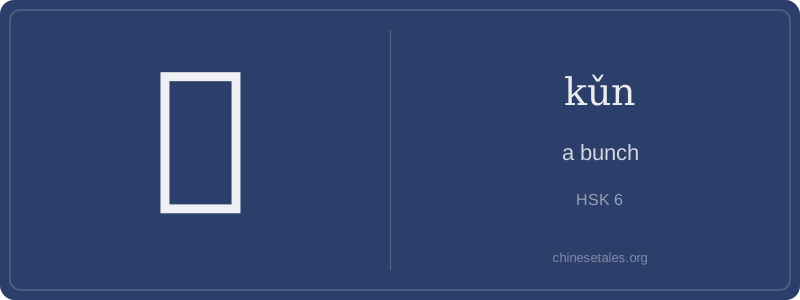
The earliest form of 捆 appears in bronze inscriptions as a hand (扌) gripping two parallel, wavy lines — representing rope — wrapped tightly around a vertical object (like a stalk or pole). Over centuries, the rope lines simplified into the top component (a variant of 困, originally meaning ‘enclosed’), while the hand radical 扌 remained firmly anchored on the left. By the Han dynasty clerical script, the rope had become the stylized ‘grass’-like strokes above 困, and the modern shape solidified: 扌 + 困 — literally ‘hand enclosing/containing’.
This visual logic directly shaped its meaning: to bind, to tie, to gather under constraint. In the Mencius, 捆 appears in agricultural metaphors — ‘捆禾’ (kǔn hé, ‘tying up grain stalks’) — underscoring diligence and order. The character never drifted into abstract ‘grouping’; instead, it retained its visceral, kinetic sense of applied pressure. Even today, when you see 捆 in a logistics label or a news headline about ‘捆扎技术’ (bundling technology), you’re seeing 2,300 years of rope-tight continuity.
At its heart, 捆 (kǔn) isn’t just ‘a bunch’ — it’s the visual and tactile idea of *binding together with force or intention*. Think of ropes tightening around a stack of firewood, or plastic straps cinching a carton: this character carries the physicality of constraint and unity. Unlike generic collective nouns like 些 (xiē) or 群 (qún), 捆 implies something *actively gathered and secured* — often for transport, storage, or protection. It’s countable: you say 一捆 (yī kǔn), 两捆 (liǎng kǔn), never *kǔn* alone.
Grammatically, 捆 functions almost exclusively as a measure word — but only for long, flexible, or bundle-able things: straw, reeds, cables, newspapers, even abstract things like ‘a bundle of problems’ (一堆问题 is common, but 一捆问题 appears in literary or ironic contexts). Learners often mistakenly use it like 个 or 条; remember: if it can’t be tied with twine, 捆 probably doesn’t fit. Also, it’s rarely used with people — that’s where 群 or 堆 steps in.
Culturally, 捆 echoes China’s agrarian roots: binding harvests was essential for survival and trade. You’ll find it in idioms like 捆绑销售 (kǔn bǎng xiāo shòu — ‘bundled sales’, i.e., forcing customers to buy two products together), revealing how the physical act of tying evolved into economic coercion. A classic mistake? Confusing it with 裹 (guǒ, ‘to wrap’) — but 裹 is about enveloping, while 捆 is about *constricting from the outside*.