掐
Character Story & Explanation
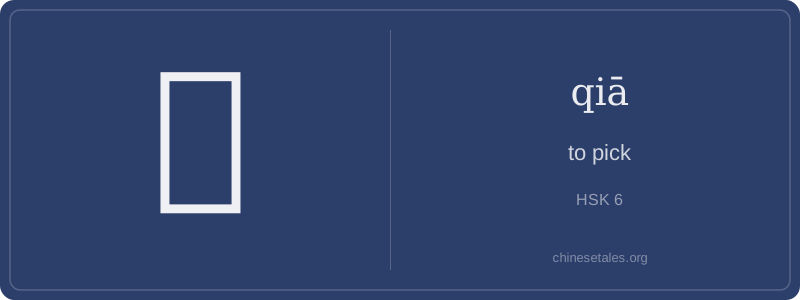
The earliest form of 掐 appears in bronze inscriptions as a compound pictograph: on the left, a simplified hand (扌), and on the right, a stylized representation of two fingers gripping a vertical line — possibly a stem or thread. Oracle bone versions are rarer but suggest the same idea: a hand exerting controlled pressure on a slender object. Over centuries, the right side evolved from a clear ‘two-finger grip’ into the modern 叵 (pǒ) component — a shape that looks like a mouth (口) with a bent stroke inside, but historically represents the squeezed object under thumb-and-forefinger duress. The 11 strokes lock in this tension: the hand radical anchors action, while the upper-right bend and lower hook visually mimic the curl of a finger clamping down.
This physicality carried into classical usage: in the Shuō Wén Jiě Zì (c. 100 CE), 掐 is defined as ‘pressing with thumb and forefinger’, citing its use in ritual contexts — priests would 掐诀 (qiā jué) to seal spiritual energy. By the Ming dynasty, it appeared in novels like Jin Ping Mei describing delicate horticultural acts, reinforcing its association with skilled, intentional removal. Even today, the character’s angular strokes feel ‘tight’ — no flowing curves, just sharp angles mirroring the snap of a stem or the bite of fingertips.
At its core, 掐 (qiā) isn’t just ‘to pick’ — it’s *to pinch and pluck with precision*, often using thumb and forefinger in a swift, deliberate motion. Think of snapping off a tender pea shoot, pinching a thread to cut it, or even the theatrical gesture of 'pinching' someone’s cheek (though that’s gentler). It carries a tactile, almost surgical concreteness: not random grabbing, but targeted, fingertip-controlled removal or pressure.
Grammatically, 掐 is a transitive verb requiring a direct object — you always 掐 something: 掐花 (pick flowers), 掐断 (pinch off/break by pinching), or 掐住 (grab hold of tightly, e.g., a throat). It rarely stands alone; learners mistakenly use it like English ‘pick’ without specifying what’s being plucked — but in Chinese, omitting the object sounds incomplete or even alarming (e.g., just saying ‘他掐了’ implies ‘he pinched [someone/something]’ — context is urgent!). It also appears in idioms like 掐头去尾 (qiā tóu qù wěi, ‘cut off head and tail’ = to edit ruthlessly).
Culturally, 掐 evokes traditional craftsmanship (e.g., jade carving where fine material is ‘pinched away’) and martial arts (qì gōng practitioners talk about 掐诀 — ‘pinching ritual hand seals’). A common error? Confusing it with 摘 (zhāi, ‘to pick fruit’), which is broader and gentler — 掐 suggests effort, control, and sometimes mild force. Also beware tone: qiā (first tone) is distinct from qiǎ (third tone, as in 掐架 — an archaic term for quarreling, now nearly obsolete).