掘
Character Story & Explanation
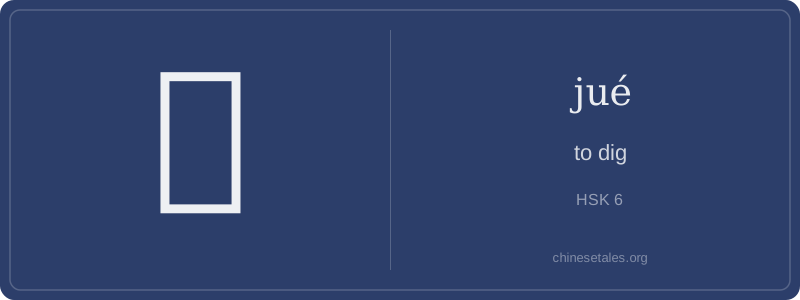
The earliest form of 掘 appears in seal script as a combination of 手 (later simplified to 扌, the 'hand' radical) and 屈 (qū, 'to bend' or 'to yield')—not a pictograph of digging itself, but a clever phonetic-semantic compound. The right side 屈 originally depicted a person crouching low, knees bent—a posture essential to digging with hands or tools. Over centuries, the crouching figure evolved into the modern 屈 component, while the left hand radical 扌 remained clear, anchoring the action firmly in human effort. By the Han dynasty, the character had stabilized into its current 11-stroke structure: three strokes for 扌, then eight for 屈—each stroke echoing the controlled tension of bending, gripping, and pulling earth upward.
This visual logic shaped its meaning deeply: 掘 wasn’t about brute force, but focused, persistent excavation—physical or intellectual. In the Records of the Grand Historian, Sima Qian used 掘 to describe how historians must 'dig into obscure records' (掘隐书) to reconstruct truth. Later, during the Song dynasty, Neo-Confucian scholars applied it to self-cultivation: 'digging into one’s own nature' (掘性) meant rigorous introspection. Even today, the character retains that sense of disciplined uncovering—its bent-knee shape still whispering, 'bend low, look deep, bring forth what lies hidden.'
Think of 掘 (jué) as the Chinese equivalent of a determined archaeologist’s trowel—not just any shovel, but the precise, deliberate tool used to uncover something buried deep: truth, history, or even buried emotions. Unlike the more general 挖 (wā), which means 'to dig' in everyday contexts (like digging a hole), 掘 carries weight, intention, and often intellectual or metaphorical force—it’s the verb you use when 'digging up evidence', 'unearthing secrets', or 'excavating ancient texts'. It’s rarely used for gardening or construction; it’s for revelation.
Grammatically, 掘 is almost always transitive and formal—expect it in written language, academic discourse, or journalistic headlines. You’ll rarely hear it in casual speech (natives say 挖 instead). It pairs naturally with abstract objects: 掘出真相 (jué chū zhēn xiàng, 'to unearth the truth'), 掘进深层心理 (jué jìn shēn céng xīn lǐ, 'to probe deep into the psyche'). Notice the common pattern: 掘 + out/into + noun—this directional precision mirrors English phrasal verbs like 'dig up' or 'dig into'.
Culturally, 掘 evokes China’s reverence for historical continuity: scholars 'dig into' classical commentaries (掘经), journalists 'dig up' corruption scandals (掘出黑幕), and even psychotherapists might 'dig into' repressed memories (掘潜意识). A common learner mistake? Using 掘 in spoken contexts where 挖 fits perfectly—or misplacing it in compound verbs (e.g., saying *掘开 instead of 挖开 for 'dig open'). Remember: 掘 is serious, scholarly, and slightly dramatic—like quoting Shakespeare at a BBQ.