掠
Character Story & Explanation
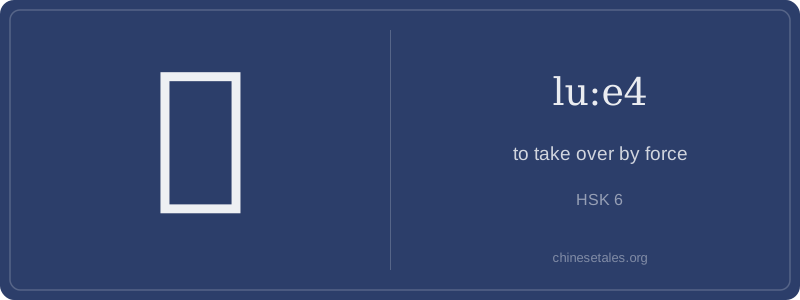
The earliest form of 掠 appears in bronze inscriptions as a hand (扌) gripping a stylized bird in flight — not holding it still, but snatching it mid-air. The right side evolved from 略 (lüè), which itself combined ‘field’ (田) and ‘strength’ (各), suggesting control over territory. Over centuries, the bird morphed into the simplified ‘京’-like top of today’s right component, while the hand radical (扌) stayed firmly anchored on the left — a visual promise that this action is *done with the hand*, violently and intentionally. Every stroke tells a story: the three dots at the top hint at feathers scattering; the downward stroke of 扌 is the arm thrusting forward; the final捺 (nà) sweep is the moment of capture.
This imagery cemented 掠’s meaning early: to snatch, to plunder, to dominate by force. In the Zuo Zhuan, it describes feudal lords ‘掠其地’ — seizing land from weaker neighbors. By Tang dynasty poetry, it gained nuance: Li Bai wrote of wind ‘掠面而过’ (skimming the face), borrowing the physical speed and lightness of the original bird-snatch to mean ‘brush past’. Yet the underlying tension remains — even poetic ‘skimming’ retains a whisper of violation, of something taken without consent. The character never lost its edge; it just learned to fly quieter.
At its core, 掠 (lüè) carries the visceral feel of a swift, violent grab — not gentle taking, but seizing by force, like a hawk diving or an army storming a gate. It’s not about ownership, but about sudden, often illegitimate, acquisition: land, power, resources, or even attention. The character breathes urgency and moral weight; in Chinese, using 掠 implies judgment — it’s rarely neutral. You’ll hear it in historical accounts of conquest, news reports on corporate raids, or literary critiques of cultural appropriation.
Grammatically, 掠 is almost always a transitive verb, requiring a direct object (e.g., 掠夺资源, ‘plunder resources’). It rarely stands alone — you won’t say ‘he掠ed’ without specifying *what* was taken. Unlike common verbs like 拿 (ná, ‘to take’), 掠 can’t be used for everyday actions (no ‘I’ll 掠 the salt’!). It also appears in fixed compound verbs like 掠过 (lüèguò, ‘to skim over’, literally ‘to seize-and-pass’ — a beautiful metaphor for fleeting attention). A classic learner mistake? Using 掠 where 拿 or 取 would be appropriate — instantly sounding overly dramatic or sinister!
Culturally, 掠 evokes imperial expansion, wartime looting, and modern anxieties about exploitation — whether of natural resources or indigenous knowledge. Its tone (fourth tone) mirrors its sharpness: abrupt, decisive, unapologetic. Interestingly, in classical poetry, 掠 softens slightly — e.g., in 杜甫’s lines about swallows ‘skimming’ eaves — showing how context can temper even the harshest characters. That duality — brutality and grace — is what makes 掠 so hauntingly precise.