搓
Character Story & Explanation
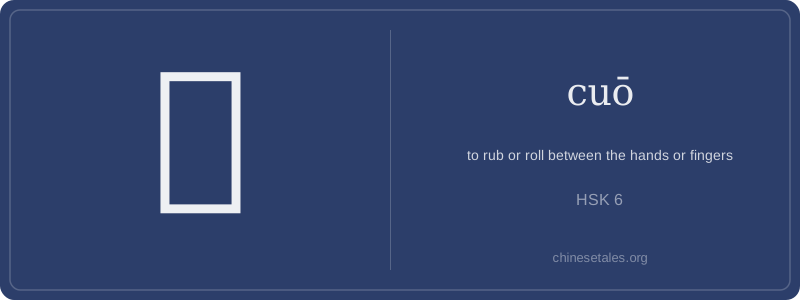
The earliest form of 搓 appears in seal script as a combination of 扌 (hand radical) and 差 (chā), which originally depicted a foot stepping unevenly — suggesting asymmetry or variation in motion. Over time, 差 evolved into the right-hand component we see today: 12 strokes total, with the three horizontal lines at the top representing repeated, layered hand movement, and the lower ‘叉’-like shape hinting at interlacing fingers. The left-hand ‘扌’ anchors it firmly in manual action — no abstract thought here, just palms meeting palm, skin on skin.
By the Han dynasty, 搓 had solidified its meaning of ‘rolling or rubbing between hands’, appearing in agricultural manuals describing how to prepare seedlings and in medical texts advising patients to 搓耳 (cuō ěr) to stimulate circulation. Its persistence across millennia reflects how bodily knowledge was codified early in Chinese practice — not as theory, but as repeatable, tactile procedure. Even today, traditional doctors recommend 搓涌泉穴 (cuō Yǒngquán xué) — rubbing the sole of the foot — a gesture unchanged since the *Huangdi Neijing*. The character itself feels like a tiny choreography written in ink.
At its core, 搓 (cuō) isn’t just ‘to rub’ — it’s about *intentional, textured friction* between the hands or fingers: rolling dough, warming cold ears in winter, kneading clay, or even nervously twisting a napkin. Unlike generic verbs like 摸 (mō, 'to touch') or 擦 (cā, 'to wipe'), 搓 implies active, circular, often rhythmic motion with purpose — physical warmth, preparation, or emotional release. It’s deeply embodied: Chinese speakers don’t just ‘do’ 搓; they *feel* the grit, the resistance, the transformation of material or mood.
Grammatically, 搓 is versatile but precise. It takes direct objects (搓手, 搓面团), appears in resultative compounds (搓圆了, 'rubbed into a perfect sphere'), and frequently pairs with reduplication for habitual or gentle action (搓搓手, 'rub one’s hands a little'). Learners often overgeneralize it — saying *搓眼睛* (cuō yǎnjīng) instead of the correct *揉眼睛* (róu yǎnjīng, 'to rub one’s eyes') — because 搓 requires two surfaces moving against each other, while 揉 is more about pressing and rotating on a single surface.
Culturally, 搓 shows up in intimate, tactile rituals: grandmothers 搓汤圆 (making glutinous rice balls for Lantern Festival), workers 搓麻绳 (twisting hemp rope by hand), or friends 搓搓肩膀 (giving a friendly shoulder rub). It’s a quiet testament to Chinese valuing *hands-on care*, where gesture carries meaning beyond utility — warmth, reassurance, craft. Mistake it for 揉 or 擦, and you risk sounding either too clinical or strangely violent.