撤
Character Story & Explanation
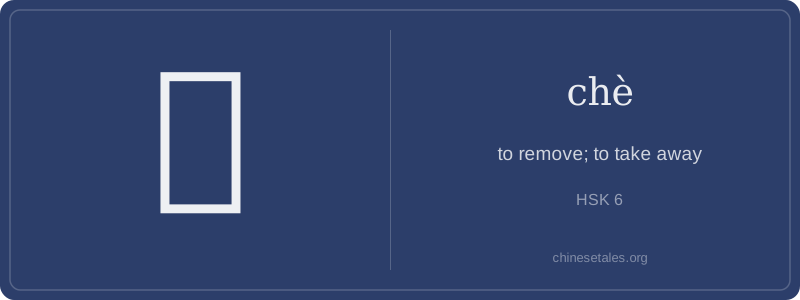
The earliest form of 撤 appears in Warring States bamboo slips as a complex character combining 扌 (hand radical), 乙 (an ancient variant of 'yǐ', representing a bent line or 'change of direction'), and 析 (xī, 'to split'). The bronze script version already emphasized manual action + structural division — picturing a hand prying apart two joined elements, like disassembling a chariot axle or unfastening a ceremonial banner. Over centuries, 乙 simplified into the top-right component (⺅), while 析 evolved into the bottom right (育 + 攵-like stroke), and 扌 remained steadfast on the left — crystallizing into today’s 15-stroke structure where every limb seems purposefully engaged in separation.
This visual logic shaped its semantic journey: from concrete dismantling (Zuo Zhuan references '撤鼓' — removing war drums to signal ceasefire) to abstract revocation (Tang dynasty edicts used 撤爵 to 'revoke noble titles'). By the Ming-Qing period, 撤 became entrenched in administrative lexicon — notably in maritime bans (撤市舶司, 'abolish the maritime trade office') and imperial censures. Its enduring power lies in this fusion: the hand (agency), the bend (intentional redirection), and the split (irreversible separation) — three strokes of sovereignty made visible.
At its core, 撤 (chè) carries the quiet authority of decisive removal — not violent erasure, but a deliberate, often official, act of withdrawal: troops from a border, a statement from a website, or a judge’s ruling from the record. Unlike generic synonyms like 拿走 (ná zǒu, 'to take away') or 删除 (shān chú, 'to delete'), 撤 implies institutional agency, reversibility, and procedural weight. It’s the verb you use when power steps back — gracefully, but with finality.
Grammatically, 撤 is almost always transitive and requires an object (e.g., 撤军, 撤销). It frequently appears in compound verbs like 撤回 (chè huí, 'to withdraw [a proposal]') or 撤销 (chè xiāo, 'to revoke [a decision]'). Crucially, it never stands alone as an imperative ('撤!' sounds jarringly military); instead, it’s embedded in formal structures: '经研究决定,撤回该任命' — 'After deliberation, the appointment has been withdrawn.' Learners often mistakenly use it for casual removal (e.g., '撤掉那把椅子') — that’s where 拿走 or 移开 belong.
Culturally, 撤 echoes China’s bureaucratic precision: every retraction, recall, or retreat must be documented, authorized, and linguistically marked. Misusing it — say, confusing it with 撤离 (chè lí, 'evacuate') — can unintentionally imply mass exodus instead of administrative reversal. Also note: 撤 is rarely used in spoken, informal registers; it’s a written-form character that breathes in policy documents, news headlines, and legal texts — making it a subtle gatekeeper to advanced Chinese literacy.