拨
Character Story & Explanation
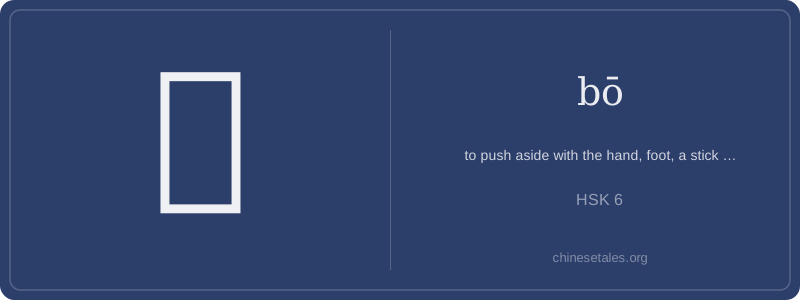
The earliest form of 拨 appears in bronze inscriptions as a hand (扌) gripping a stylized, curved object resembling a hairpin or tuning peg — likely representing the act of plucking or adjusting strings on ancient zithers like the qin. That curved element evolved into the right-hand component 發 (fā), which originally depicted a hand releasing an arrow from a bow. Over centuries, 發 simplified into 发 (modern simplified form), but the core idea remained: *a hand initiating directed motion*. By the Han dynasty, the character stabilized as 扌+發 — eight strokes total — with the left radical anchoring it firmly in the domain of manual action.
This musical origin explains why 拨 so naturally extended to any action involving *initiation*, *adjustment*, or *removal of barriers*:拨弦 (plucking strings), 拨云见日 (‘push aside clouds to see the sun’ — a classical idiom for sudden clarity), and even bureaucratic acts like 拨款 (allocating funds). In the Tang poet Li Bai’s line '拨云寻古道', the character evokes both physical gesture and metaphysical revelation — a perfect fusion of form, function, and philosophical weight.
Think of 拨 (bō) as the Chinese equivalent of a precise, decisive 'sweep' — like a conductor’s baton cutting through air to cue an orchestra, or a chef flicking herbs off a knife with one swift wrist motion. It’s not brute force; it’s controlled, directional displacement: pushing aside,拨开 a curtain,拨动 a switch,拨号 a phone number. Unlike generic verbs like 推 (tuī, 'to push') or 移 (yí, 'to move'), 拨 implies agency, intentionality, and often a tool-mediated action — your finger, a stick, even a digital interface.
Grammatically, 拨 shines in verb-complement structures and compound verbs. You don’t just ‘dial’ — you 拨号 (bō hào, 'push-number'); you don’t just 'clear a path' — you 拨开 (bō kāi, 'push-open'). It frequently appears in resultative complements (e.g., 拨不动 — 'can’t budge') and is indispensable in tech contexts: 拨打 (bō dǎ, 'to make a call'), 拨通 (bō tōng, 'to get through'). Learners often mistakenly use 拨 where 接 (jiē, 'to receive') or 打 (dǎ, 'to hit/make') would fit — but 拨 is always about *initiating* contact or *removing obstruction*, never passive reception.
Culturally, 拨 carries a subtle sense of authority and control — a minister '拨款' (bō kuǎn, 'allocates funds') doesn’t beg or request; they direct resources. Confusing it with similar-sounding characters (like 拔 or 波) leads to hilarious errors: saying 拨草 instead of 拔草 ('pull weeds') makes it sound like you’re *swiping* weeds sideways! Remember: 拨 is hand + 'hairpin' — a gesture of precise, elegant intervention.