介
Character Story & Explanation
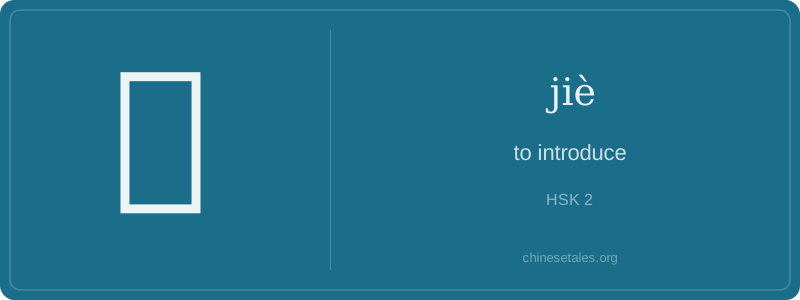
The earliest form of 介 appears in oracle bone inscriptions as a stylized human figure with arms raised and legs apart — not dancing, but *standing guard* or *marking a boundary*. Imagine a sentry at a gate: two legs (the two downward strokes), a torso (the central vertical stroke), and arms extended sideways (the top horizontal stroke). Over centuries, the arms simplified into a single horizontal line, the legs fused into two sharp, angled strokes resembling ‘<’, and the human radical (人) remained embedded in its structure — visible if you tilt your head: the left stroke + top stroke + right stroke together echo the shape of 人, but stretched wide, like a person holding open a doorway.
This visual idea of ‘a person standing between’ became the semantic anchor. In classical texts like the *Zuo Zhuan*, 介 appears in phrases like ‘介胄之士’ (jièzhòu zhī shì) — ‘armored warriors’, where 介 meant ‘armor’ (i.e., protective layer *between* body and danger). From physical armor to social mediation to emotional boundaries (as in 介意), the meaning evolved along the axis of *intervention* and *interposition*. The character didn’t shrink — it deepened, becoming less about armor and more about awareness of space, role, and respect.
At first glance, 介 looks deceptively simple — just four strokes and a human radical (人), but don’t be fooled: this tiny character is a semantic powerhouse. Its core feeling isn’t just ‘to introduce’ — it’s about *mediation*, *intervention*, and *standing between*. Think of it as the linguistic equivalent of a polite handshake, a bridge, or even a gentle nudge into a new role. In modern usage, it almost never stands alone as a verb like ‘I introduce’; instead, it appears in compound verbs (介绍, jièshào) or formal expressions like 介意 (jièyì, ‘to mind’ — literally ‘to intervene in one’s thoughts’). That subtle shift from physical mediation to psychological boundary-setting is key.
Grammatically, learners often overextend 介 by trying to use it bare — but you’d never say *‘Wǒ jiè tā’* for ‘I introduce him.’ You need the full verb 介绍. Also, watch out for its passive-sounding but actually active role in phrases like ‘bù jièyì’ (‘don’t mind’) — here, 介 means ‘to intervene in’, so ‘not intervening in one’s feelings’ becomes ‘not minding’. It’s elegant, indirect, and very Chinese.
Culturally, 介 reflects how deeply relational Chinese communication is: even ‘minding’ something implies an intrusion into your inner space — a concept that feels almost tactile. A common mistake is confusing 介 with similar-sounding words like 借 (jiè, ‘to borrow’) or 忌 (jì, ‘to avoid’), but those carry entirely different radicals and connotations. Mastering 介 means mastering the art of gentle, respectful connection — no shouting, just stepping in, just right.