擎
Character Story & Explanation
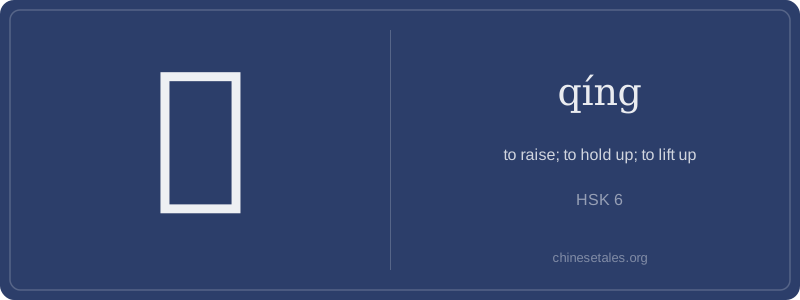
The earliest form of 擎 appears in late Warring States bamboo texts — not oracle bones, but already highly stylized. Its left side 扌 (hand radical) anchors the action, while the right side was originally 經 (jīng), meaning ‘to regulate’ or ‘to govern’, but simplified over centuries into 京 (jīng, ‘capital’). Why ‘capital’? Because the capital city stood at the center of imperial power — the highest, most elevated point in the realm. So visually, 擎 fused ‘hand’ + ‘capital’ = ‘to raise as if placing something at the apex of authority’. Stroke by stroke, the top of 京 evolved from a clear ‘lid’ shape (亠+口) into today’s compact, angular crown-like structure above two crossed strokes — evoking arms straining upward.
By the Han dynasty, 擎 appeared in texts like the Huainanzi, describing sages ‘擎天地而立’ — holding up heaven and earth. This wasn’t literal physics, but moral cosmology: the virtuous ruler *supports* cosmic order. In Tang poetry, Li Bai used 擎 to describe a crane lifting its wings — transforming physical motion into spiritual ascent. The character never lost its vertical ambition: every stroke pushes upward, and even its 16-stroke count feels like a deliberate heft — no light lifting here. Its modern rarity isn’t decline, but conservation: it’s kept in the linguistic vault for when ordinary words won’t do.
Think of 擎 (qíng) as the ‘heroic lift’ — not just any raising, but a deliberate, often solemn or dramatic act of holding something aloft with both strength and reverence. It’s the verb you’d use for a soldier hoisting a flag, a monk lifting a sacred relic, or a poet describing stars suspended in the night sky. Unlike common verbs like 举 (jǔ) — which is neutral and everyday — 擎 carries weight, gravity, and sometimes even mythic resonance. You’ll rarely hear it in casual speech; it lives in literature, formal speeches, and set phrases.
Grammatically, 擎 is transitive and almost always appears with an object — never standalone. It doesn’t take aspect particles like 了 or 过 easily (‘擎了’ sounds archaic), and it resists reduplication (no *擎擎). Instead, it thrives in compound verbs (e.g., 高擎, 手擎) or as a literary verb in parallel structures: ‘他双手擎天,怒目圆睁’ — here, the physical action mirrors cosmic defiance. Learners often overuse it trying to sound ‘more Chinese,’ but native speakers reserve it for moments that demand gravitas — like calling a newborn ‘擎天之柱’ (pillar holding up the sky) only in metaphor, never literally.
Culturally, 擎 taps into China’s long tradition of symbolic elevation: raising banners during rebellion, lifting ancestral tablets in rites, or describing deities holding celestial bodies. A classic mistake? Using it where 举 or 托 fits better — saying ‘我擎着伞’ instead of ‘我撑着伞’ will make listeners blink. Also, beware tone: qíng (second tone) is easily mispronounced as qǐng (third tone, ‘to invite’) — a slip that turns ‘holding high’ into ‘inviting high,’ which isn’t a thing.