拧
Character Story & Explanation
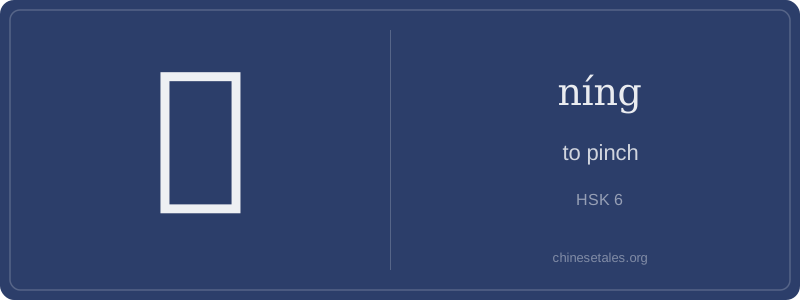
The earliest form of 拧 appears in seal script as a combination of 扌 (hand radical) and 宁 (níng, originally depicting a *roof over a heart*, later simplified to mean 'peace' but phonetically borrowed here). Though 宁 looks serene, its role here is purely phonetic — the ancients chose it because its pronunciation matched the action's sound. Visually, the modern character evolved cleanly: three strokes for the hand (扌), then the five-stroke 宁 — no pictographic trace remains of twisting; instead, it’s a brilliant phonosemantic compound where meaning lives in the radical and sound in the right side.
This clever design reflects Classical Chinese efficiency: rather than invent a new pictograph for 'pinch/twist,' scribes attached the familiar hand radical to a known phonetic component. By the Tang dynasty, 拧 was fully standardized in texts describing textile work — like 拧纱 (wringing spun thread) — and later expanded into bodily actions and figurative use. Its stability across 1,300+ years shows how well this phonosemantic pairing captured the essence: *hand + níng-sound = the sharp, controlled squeeze that defines the word.*
Think of 拧 (níng) not as a stiff dictionary definition like 'to pinch,' but as the *feeling* of controlled torsion — twisting, wringing, or gripping with focused pressure. It’s tactile and intentional: you don’t just ‘touch’ — you *apply torque*. That’s why it’s used for twisting a towel dry (拧毛巾), pinching a child’s cheek playfully (拧脸蛋), or even ‘twisting’ someone’s words (拧曲事实). The action always implies resistance overcome by hand + will.
Grammatically, 拧 is almost always a transitive verb requiring a direct object — you *must* say what you’re twisting or pinching. Learners often omit the object or misuse it as an intransitive verb ('The towel is拧ing'), which sounds nonsensical to native ears. Also watch tone: níng is the default HSK 6 meaning, but nǐng appears in dialectal or colloquial imperatives ('Nǐng it harder!'), and nìng shows up in fixed literary phrases like 拧劲儿 (nìng jìn’r, 'stubbornness') — where the 'twist' becomes metaphorical rigidity.
Culturally, 拧 carries subtle warmth or intimacy: parents 拧孩子的脸蛋 (pinch cheeks), chefs 拧干蔬菜 (wring out greens), mechanics 拧紧螺丝 (tighten screws). But it can also signal tension — 拧眉 (nǐng méi, 'furrow brows') shows inner strain. A common mistake? Confusing it with 扭 (niǔ, 'to twist' more broadly, often involving the whole body or direction change) — 拧 is precise, manual, and localized, like fingers on flesh or fabric.