搁
Character Story & Explanation
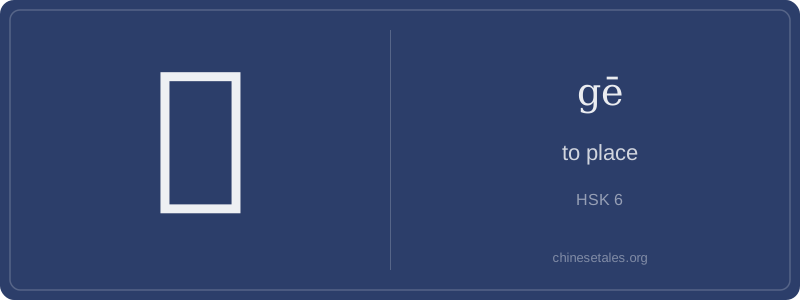
The earliest form of 搁 appears in late Warring States bamboo texts, evolving from the hand radical 扌 (shǒu — 'hand') fused with 各 (gè), which originally depicted a foot descending onto ground — suggesting 'arrival' or 'setting down'. In bronze script, 各 was a pictograph of a foot (止) above a mouth-like symbol (口), representing 'reaching a designated place'. When combined with 扌, the character visually encoded 'hand bringing something to its intended resting place' — a vivid, embodied act of placement. By the Han dynasty, the structure stabilized: three strokes for the hand radical (扌), followed by the nine-stroke 各 — totaling twelve strokes, each reinforcing control and precision.
This visual logic shaped its semantic journey. In early texts like the Shuōwén Jiězì, 搁 was glossed as 'to settle, to deposit', emphasizing stability over motion. By the Ming-Qing vernacular novels, it acquired nuance: in Golden Lotus, characters '搁下脸' (gē xià liǎn — 'set aside one’s face') to suppress anger — revealing how 搁 extends beyond physics into emotional and social restraint. Its modern colloquial use as a preposition ('搁这儿') stems from this idea of 'fixing location' — the foot (各) anchoring the hand’s action in space, turning verb into spatial marker.
Think of 搁 (gē) as Chinese’s version of the English verb 'to park' — not for cars, but for objects, ideas, or even emotions: you don’t just *put* something down, you *park it there*, often with a hint of intentionality, temporary suspension, or quiet finality. It’s less about physical placement (like 放 fàng) and more about settling something into a specific spot or state — a book on a shelf, a plan on hold, or resentment in your heart. Unlike generic verbs, 搁 carries subtle weight: it implies the object stays put, sometimes stubbornly.
Grammatically, it’s versatile but picky. As a transitive verb, it always takes a direct object and often pairs with location complements (e.g., 搁在桌上 gē zài zhuō shàng — 'place on the table') or aspect particles like 过 (gēguò — 'has been placed'). Crucially, it rarely stands alone in commands ('Gē it!' sounds unnatural); instead, it appears in descriptive or narrative contexts. Learners often misapply it where 放 or 放置 would be neutral — but 搁 adds flavor: a sigh before setting down a heavy box, or the deliberate pause before shelving an uncomfortable truth.
Culturally, 搁 echoes China’s pragmatic sensibility toward time and space: things aren’t just moved — they’re *positioned*, sometimes indefinitely. In northern dialects (especially Beijing), 搁 also functions as a colloquial preposition meaning 'at' or 'in' (e.g., 搁家 gē jiā — 'at home'), a usage so entrenched it’s almost invisible to native speakers — yet baffling to learners who expect only 'to place'. That’s why HSK 6 includes it: not just for the verb sense, but for its chameleonic role in real spoken Chinese.