携
Character Story & Explanation
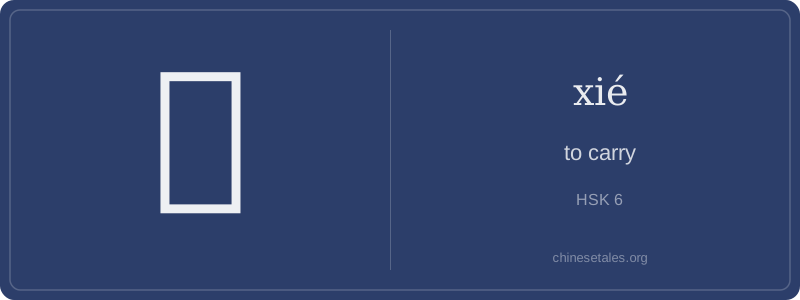
The earliest form of 携 appears in bronze inscriptions as a hand (扌) gripping a bent object resembling a rope or strap, with a phonetic component 䜌 (luán) — later simplified to 協. The left side 扌 (hand radical) anchors its physical action, while the right side originally conveyed both sound and the idea of coordination: two hands working together. Over centuries, the complex 䜌 evolved into today’s 協 — not the standalone character 协, but a stylized phonetic echo. Notice how the three horizontal strokes in the top of 協 resemble tied strands — visualizing something bound *together* and *carried*.
This coordination theme deepened in classical usage: in the Book of Rites, 携 appears in phrases like 携幼扶老 (xié yòu fú lǎo) — 'carrying the young and supporting the elderly' — framing care as active, embodied responsibility. By Tang poetry, it described travelers bearing memories across mountains (e.g., Wang Wei: '携琴载酒入烟霞'). Its visual logic remains intact: every stroke reinforces the idea of a hand deliberately guiding, holding, and moving something inseparable from the self.
Imagine you’re at Beijing West Railway Station, rushing to catch the G-train to Xi’an — suitcase in one hand, your grandmother’s handwritten recipe book clutched tightly in the other. You’re not just *holding* it; you’re *carrying it along with you*, intentionally, protectively, as part of your journey. That’s 携 (xié): not passive carrying like 拿 (ná) or lifting like 举 (jǔ), but purposeful, often emotional or consequential accompaniment — a child, a secret, a tradition, or even a disease. It implies agency and continuity: what you 携 stays with you, shaping the trip ahead.
Grammatically, 携 is almost always transitive and formal — you’ll rarely hear it in casual speech ('I’m carrying my lunch' → 我带着午饭, not 我携着午饭). It pairs with nouns denoting people, objects, or abstract concepts (e.g., 携带病毒, 携手合作), and frequently appears in written contexts: news headlines, policy documents, literary descriptions. Learners mistakenly use it where 带 (dài) suffices — but 携 elevates the act: 带手机 is 'bring your phone'; 携手机 suggests solemn preparedness, like a diplomat entering negotiations.
Culturally, 携 carries subtle weight: 携手 (xié shǒu) means 'to join hands' — but metaphorically, it’s about alliance, unity, and shared responsibility (think joint ventures or diplomatic agreements). Misusing it as a verb for everyday actions sounds stilted or even comically bureaucratic. Also, watch tone: xié (second tone) is easily mispronounced as xiě (third tone, 'to write') — a slip that could turn 'carrying hope' into 'writing hope'!