攒
Character Story & Explanation
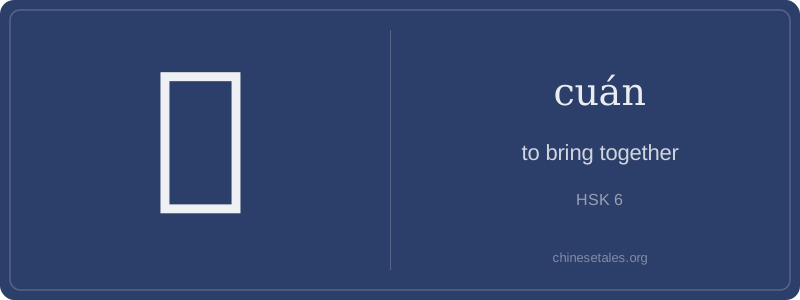
The earliest form of 攒 (found in late Warring States bamboo slips) wasn’t a single character but a vivid compound: 扌 (hand radical) + 赞 (zàn, originally depicting two hands offering a shell — symbolizing praise or contribution). Over centuries, 赞 simplified into the top-right component we see today — not the modern 赞, but a cursive, condensed form where the ‘two hands’ became two stacked ‘X’-like strokes (two ×), and the ‘shell’ morphed into the bottom ‘first stroke’ of the current character. Crucially, the left hand radical 扌 remained dominant — anchoring the meaning in *manual, deliberate action*.
This visual logic shaped its meaning: bringing things together *by hand*, with force and purpose. In the Shuōwén Jiězì (121 CE), it was defined as ‘to gather tightly, like stacking firewood’. By the Tang dynasty, poets used it for crowds surging (‘people cuán like ants’) and clouds thickening before storms — always implying density, motion, and imminent release. Its modern shape — 19 strokes — preserves this ancient tension: the left hand reaches, the right side compresses, and the whole character feels like something held taut just before bursting.
At its heart, 攒 (cuán) is about convergence — not just physical gathering, but the energetic, often urgent, act of pulling things *toward a single point*. Think of raindrops coalescing on a leaf, or villagers crowding around a storyteller: it’s dynamic, collective, and slightly charged. Unlike the neutral ‘collect’ (收集 shōují), 攒 implies intention, effort, and sometimes even tension — you’re *wrestling* elements into unity.
Grammatically, it’s versatile but picky: as a verb, it usually takes a direct object and often appears in serial verb constructions (e.g., 攒起来 cuán qǐlái — ‘gather up’) or with directional complements. Learners mistakenly use it like ‘save money’ — but that’s zǎn (攒钱), a *different pronunciation and semantic path*. When you hear cuán, think *crowd, pile, cluster*: 攒动 (cuán dòng — ‘to surge/throng’), 攒聚 (cuán jù — ‘to congregate’). The tone shift to zǎn only happens in financial or accumulative contexts (like saving money or energy), where it’s semantically distinct and etymologically divergent.
Culturally, cuán carries an almost visceral quality — classical texts describe clouds ‘cuán’ before thunder, or soldiers ‘cuán’ behind shields. It’s never passive; it’s a small explosion of coordination. A common error? Using it for abstract accumulation (e.g., ‘accumulate knowledge’) — that’s 积累 jīlěi. Reserve cuán for tangible, kinetic gathering — bodies, objects, light, even emotions pressing in from all sides.