摊
Character Story & Explanation
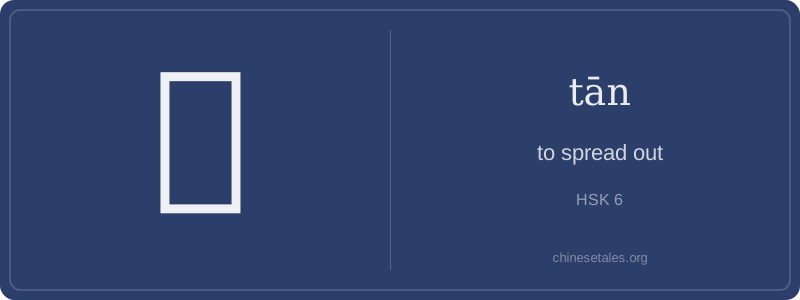
The earliest form of 摊 appears in seal script as 扌 (hand radical) + 毅 (yì, later simplified to 尼), but crucially, the right side originally depicted a *flat surface with objects laid upon it* — think of oracle bone inscriptions showing a hand placing items onto a low platform or mat. Over centuries, the right component evolved from a pictograph of layered objects into 尼 (ní), which phonetically anchors the pronunciation. By the Tang dynasty, the structure stabilized into today’s 扌+难 (nán) — wait, no! That’s a common misconception: the modern right side is actually 尼 (ní), not 难 (nán); the confusion arises because handwritten forms blurred the distinction, and many fonts now render it identically to 难’s top — but etymologically, it’s 尼, chosen for sound, not meaning.
This visual logic — hand + flat arrangement — cemented 摊’s core sense of ‘making horizontal and visible’. In classical texts like the *Dream of the Red Chamber*, 摊 appears when characters ‘摊开书卷’ (spread open scrolls), emphasizing revelation and intimacy. The character never meant ‘to scatter’ (that’s 撒 sǎ) or ‘to pile’ (堆 duī); its essence has always been *controlled extension*: one hand, one surface, one deliberate act of opening up — whether silk, truth, or trouble.
At its heart, 摊 (tān) is about *unfolding agency* — not just spreading cloth or papers, but actively laying something out with intention, often to make it visible, accessible, or negotiable. Think of a street vendor unfurling a cloth to display wares, or a detective spreading evidence across a table: it’s tactile, deliberate, and slightly performative. Unlike passive verbs like 放 (to place), 摊 implies an *extension into space* — flat, wide, and open.
Grammatically, 摊 is wonderfully flexible: it can be transitive (摊开地图 — 'spread out the map'), used in resultative compounds (摊平 — 'flatten by spreading'), or even take the 'ba' construction (把文件摊在桌上 — 'put the documents spread out on the table'). A classic learner trap? Using 摊 for 'to set up a stall' — that’s actually 摆摊 (bǎi tān), where 摊 here is a *noun* meaning 'stall', not the verb! Confusing the noun and verb forms trips up even advanced students.
Culturally, 摊 carries subtle connotations of informality and improvisation — street markets (地摊), makeshift arrangements (临时摊子), or even metaphorical 'spreading' of responsibility (摊派). It rarely appears in formal bureaucratic language; you won’t see 摊 in a government white paper — but you’ll hear it in haggling, storytelling, or crisis management ('摊开问题' — 'lay bare the problem'). That grounded, hands-on energy is its linguistic fingerprint.