搅
Character Story & Explanation
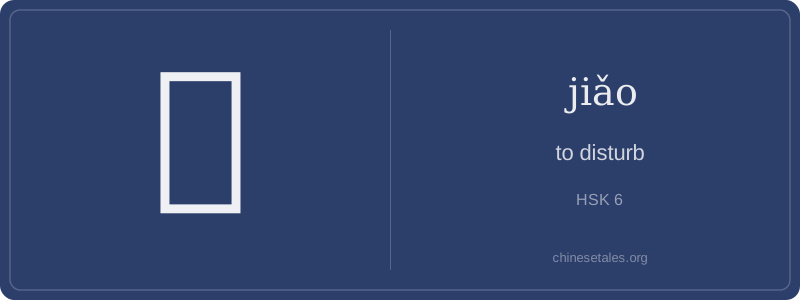
The earliest form of 搅 appears in seal script as a hand radical (扌) gripping a complex phonetic component that looked like a twisted rope or coiled thread — evoking vigorous twisting motion. Over time, the right side simplified from ancient forms like 爵 (a ritual wine vessel, used phonetically) into the modern 交 (jiāo), which itself means ‘to cross’ or ‘intersect’ — visually reinforcing the idea of things being entangled, interwoven, or forced together. By the Han dynasty, the character stabilized into its current shape: 扌 (hand action) + 交 (crossing/tangling), 12 strokes total — each stroke mirroring the effort of turning, winding, and disrupting order.
This visual logic became semantic truth: in classical texts like the Book of Rites, 搅 described physically churning sacrificial broth to ensure even heat — a sacred act of intentional disruption. Later, in Ming-Qing vernacular fiction, it leapt metaphorically: ‘搅得满城风雨’ (stirring up wind and rain across the city) captured political unrest. Even today, the character’s shape whispers its meaning: the left hand reaches in; the right side — 交 — shows two lines crossing, clashing, tangling. No passive disturbance here — only deliberate, hands-on agitation.
At its heart, 搅 (jiǎo) isn’t just ‘to disturb’ — it’s the feeling of *introducing motion into stillness*, like stirring thick porridge until it bubbles or shaking up a quiet room with sharp words. It implies active, often physical, intervention that changes the state: you don’t just ‘disturb’ silence—you 搅 it, making it turbulent, messy, or unpredictable. That visceral sense of *agitation through contact* is why it pairs so naturally with nouns like 风 (wind), 局势 (situation), and 心 (heart).
Grammatically, 搅 is almost always transitive and appears in compound verbs (e.g., 搅乱, 搅和) or as part of fixed idioms. Learners often mistakenly use it alone as an intransitive verb ('The situation stirred') — but no: it *requires* an object (搅局, 搅浑水). Also, it rarely stands at sentence end; instead, it drives action forward: ‘He 搅了这盘棋’ (He disrupted this game) — not ‘He stirred.’ The ‘-le’ particle is nearly mandatory for completed action.
Culturally, 搅 carries mild negative weight — it’s rarely neutral. To 搅局 (jiǎo jú) is to crash a meeting like an uninvited guest; to 搅和 (jiǎo huo) soup is fine, but to 搅和是非 (stir up trouble) is socially toxic. A common slip? Using it where English says ‘bother’ — but 搅 doesn’t mean ‘inconvenience’; that’s 麻烦 (máfan). Think: if it creates *chaos*, *turbulence*, or *unwanted motion*, it’s probably 搅.