攻
Character Story & Explanation
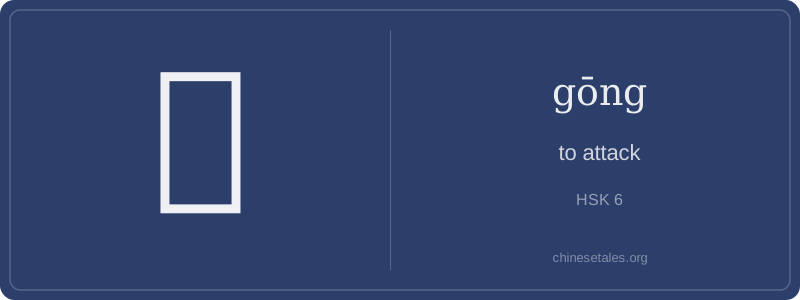
The earliest form of 攻 appears in bronze inscriptions as a combination of two elements: a hand holding a weapon (later stylized into the radical 攵—‘step with a rod,’ implying action) and 工 (gōng), which originally depicted a carpenter’s T-square—a symbol of precision and craft. So the ancient pictograph wasn’t just ‘hitting’; it was ‘striking with deliberate, skilled force.’ Over centuries, the weapon morphed into the left-hand component (a simplified 工), while the right became the standardized ‘walking with a rod’ radical 攵—7 strokes total, each one reinforcing intentionality.
This precision-rooted origin explains why 攻 evolved beyond battlefield violence: in classical texts like the *Zuo Zhuan*, 攻 describes diplomatic pressure (‘attacking with rhetoric’) and scholarly rigor (‘attacking a text to interpret it’). By the Tang dynasty, poets used 攻 in metaphors like ‘攻心’ (attack-the-heart)—meaning to win someone over through insight, not coercion. Even today, when a student says 我要攻下这门课 (I’ll conquer this course), they’re invoking 3,000 years of linking focused effort with strategic offense.
At its heart, 攻 (gōng) isn’t just ‘to attack’ like a cartoon villain swinging a sword—it’s about *directed, purposeful force*: launching an offensive in war, debate, research, or even mastering a skill. Think of it as the Chinese verb for ‘going on the offensive’—energetic, strategic, and often collective. You’ll rarely see it alone; it almost always appears in compounds (like 攻击 or 进攻) or as part of formal/academic verbs (e.g., 攻读 ‘to undertake advanced study’). It carries weight—no casual texting with 攻!
Grammatically, 攻 is nearly always transitive and prefers formal or written contexts. You won’t say *‘I attack the pizza’*—that’s 咬 or 吃—but you *will* say 他正在攻读博士学位 (He is pursuing a doctoral degree), where 攻 implies disciplined, sustained effort against intellectual resistance. Learners often mistakenly use it where 攻击 (gōngjī) or 进攻 (jìngōng) would be more natural—remember: 攻 by itself feels incomplete, like ‘launch’ without ‘the missile.’
Culturally, 攻 reflects China’s historical emphasis on strategy over brute force—the Art of War opens with ‘The supreme art of war is to subdue the enemy without fighting,’ yet the very word 攻 anchors that idea: not mindless assault, but calculated pressure. A common error? Confusing it with 工 (gōng, ‘work’) or 功 (gōng, ‘merit’)—same sound, totally different worlds. And no, it’s *not* used for romantic ‘attacking’—that’s 追 (zhuī). Respect the semantics!