敞
Character Story & Explanation
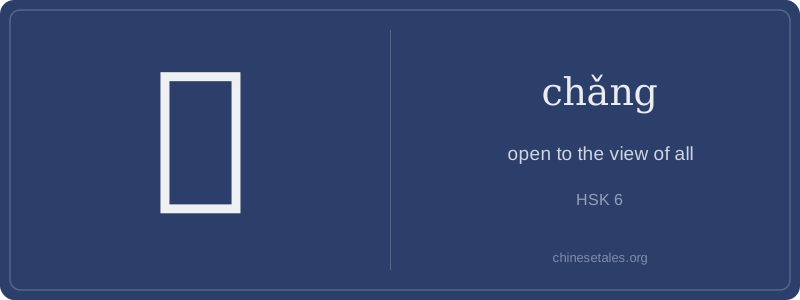
The earliest form of 敞 (found in bronze inscriptions) fused two key elements: a large, roofed structure (represented by 尚 — later simplified to 尚’s top part, 丷+口) and a hand holding a tool (攴, later evolved into 攵, the ‘tap’ or ‘action’ radical). This wasn’t just any building — it depicted a ceremonial hall with its central beam removed and roof rafters fully exposed to sky and view. The hand wasn’t striking, but *revealing*: deliberately stripping away coverings to make the interior visible. Over centuries, 尚’s lower part morphed into 冖 (a covering), then further stylized into the current upper component (+冖+一), while 攴 solidified into the familiar ‘walking stick’ radical 攵 — preserving the idea of *intentional action toward exposure*.
This visual logic shaped its semantic journey. In the *Zuo Zhuan*, 敞 described gates left unbarred during diplomatic receptions — not for entry, but to signal *no hidden intentions*. By the Tang dynasty, poets used 敞 to depict mountain vistas ‘unfolding openly’, linking spatial vastness with mental clarity. Its modern sense — ‘open to all view’ — isn’t metaphorical stretch; it’s a direct inheritance from that ancient ritual act: removing barriers *so nothing remains unseen*. Even today, when you say 敞亮, you’re echoing a Bronze Age architect who believed truth belonged under open sky.
At its heart, 敞 isn’t just ‘open’ — it’s *unreservedly, conspicuously open*: doors flung wide, curtains drawn back, secrets laid bare. Think less ‘ajar’ and more ‘stage curtain rising’. It carries a sense of exposure, visibility, and intentional lack of concealment — often with positive connotations of generosity (an open heart) or transparency (an open policy), but sometimes with vulnerability (an exposed weakness). Unlike generic 开 (kāi), 敞 implies both physical spaciousness *and* psychological or social openness.
Grammatically, 敞 functions almost exclusively as a stative verb or adjective in compound structures — you’ll rarely see it alone. It appears in fixed patterns like 敞开 (chǎng kāi, ‘to throw wide open’), 敞亮 (chǎng liàng, ‘bright and airy’), or as the head of descriptive phrases: 敞着门 (chǎng zhe mén, ‘with the door wide open’). Learners often mistakenly use it where 开 suffices — saying *‘他敞了窗户’ instead of ‘他打开了窗户’ — which sounds oddly literary or even archaic. 敞 needs that weight: it opens *for visibility*, not just access.
Culturally, 敞 taps into deep Chinese values around sincerity (诚 chéng) and unguarded authenticity. In classical texts, 敞心扉 (chǎng xīn fēi, ‘to open one’s heart’s gate’) evokes Confucian ideals of moral transparency. Modern usage leans practical — describing sunlit apartments or inclusive corporate cultures — but the character still whispers of ethical exposure: to be 敞 is to choose visibility over safety, trust over control. A common slip? Using it for ‘open a file’ (computing) — nope, that’s 打开 (dǎ kāi). 敞 belongs to spaces, hearts, and policies — not PDFs.