敷
Character Story & Explanation
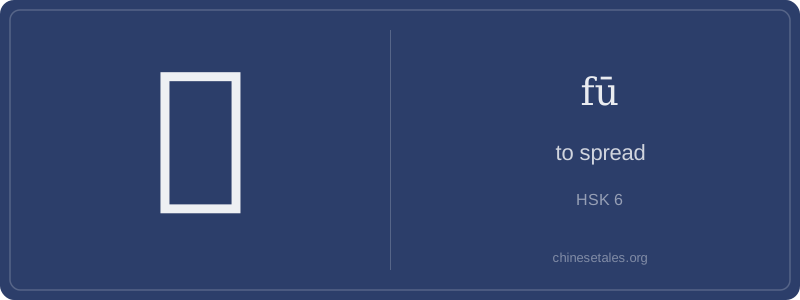
The earliest form of 敷 appears in seal script as a combination of 甫 (fǔ, originally a pictograph of a sprouting plant in a field, later phonetic) above 攴 (pū, a hand holding a stick — the ‘strike’ radical, later simplified to 攵). In bronze inscriptions, 甫 was already stylized to suggest orderly growth, and adding 攴 transformed it into an action: ‘to apply with rhythmic, controlled motion’ — like a healer tapping a salve onto skin or an official stamping decrees across documents. The modern 15-stroke form preserves this logic: 甫 (7 strokes) on top, 攵 (4 strokes) at bottom right, with the middle section (⺈ + 又) evolving from ancient variants of ‘hand’ and ‘tool’.
This visual logic shaped its meaning: from early Zhou texts like the *Book of Documents*, 敷 described the sage-king’s ‘spreading’ of virtue — not by force, but through calibrated, repeated acts of governance and healing. By the Han dynasty, medical classics like *Huangdi Neijing* used 敷 specifically for topical herbal applications, cementing its association with layered, therapeutic coverage. Even today, the character’s structure whispers: ‘methodical application’ — every stroke echoes the rhythm of a hand pressing medicine onto skin or ink onto silk.
At its heart, 敷 (fū) is about deliberate, even ceremonial, spreading — not the casual smearing of peanut butter, but the careful application of medicine to a wound, the measured laying out of policy across a region, or the dignified distribution of authority. It carries weight, intention, and often formality: you don’t ‘敷’ ketchup on fries; you ‘敷’ ointment, ‘敷’ principles, or ‘敷’ imperial edicts. Think of it as ‘spreading with gravity.’
Grammatically, 敷 is almost always transitive and appears in compound verbs like 敷衍 (fūyǎn) or 敷设 (fūshè), rarely alone. Learners mistakenly use it like 涂 (tú, ‘to smear’) or 擦 (cā, ‘to wipe’), but 敷 implies coverage *with purpose* — often layered, methodical, and sometimes even performative. Notice how it’s used in passive constructions (‘被敷上药’) or abstract domains (‘敷布政令’ — ‘to promulgate policies’), never for spontaneous action.
Culturally, 敷 evokes classical bureaucratic precision and medical tradition — think of Tang dynasty physicians applying herbal plasters or Ming officials ‘spreading’ Confucian rites across frontier counties. A common pitfall? Overusing it in spoken Mandarin: it’s literary and formal. Saying ‘我敷了面膜’ sounds oddly stately — native speakers usually say ‘我贴了面膜’. Reserve 敷 for writing, official contexts, or when you want that subtle air of solemn care.