昂
Character Story & Explanation
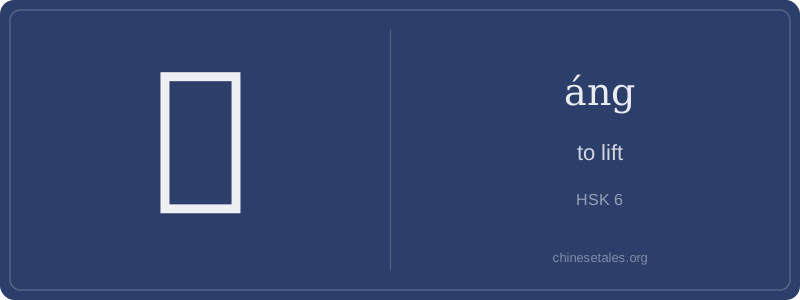
The earliest form of 昂 appears in bronze inscriptions as a pictograph combining two key elements: a person (人 rén) with arms raised, and a sun-like circle (⊙) above—symbolizing the act of lifting one’s head toward the sky or sun. Over time, the person evolved into the left-side component (⺅, a variant of 丿 + 日), while the sun solidified into the radical 日 at the top right. By the seal script era, the structure had settled into its modern shape: the upper-right 日 (sun), the middle horizontal stroke (一), then the descending strokes forming the ‘lifting’ gesture—eight strokes total, each echoing upward motion.
In the Classic of Poetry (Shījīng), 昂 appears in lines describing nobles raising their heads in solemn address ('昂然自若' — 'calmly holding one’s head high'). Its visual logic is deeply intuitive: the 日 radical suggests brightness and height, while the lower strokes mimic the arc of a lifted chin or rising flame. This fusion of celestial imagery and bodily poise makes 昂 uniquely expressive—it’s not just vertical movement, but *luminous elevation*.
At its heart, 昂 isn’t just ‘to lift’—it’s about *upward intentionality*: lifting your head, your voice, your spirit. It carries an elegant, almost ceremonial weight—think of a scholar raising his gaze in resolve or a dragon lifting its head in classical poetry. Unlike casual verbs like 抬 (tái) or 举 (jǔ), 昂 implies dignity, pride, and conscious elevation—not physical force but inner posture made visible.
Grammatically, 昂 is rarely used alone in modern speech; it shines in literary compounds and fixed expressions. You’ll find it as a verb in formal writing (昂首挺胸 áng shǒu tǐng xiōng — 'hold one’s head high and chest out'), as a component in adjectives like 昂贵 (áng guì, 'expensive' — literally 'lifted in value'), and even as a rare verb meaning 'to rise' in economic contexts (物价昂扬 wù jià áng yáng, 'prices soar'). Learners often mistakenly use it conversationally like 'lift something up'—but no: you don’t 昂 a box. You *do* 昂 your chin when declaring truth.
Culturally, 昂 reflects the Confucian ideal of upright bearing (立 lì) — how moral integrity manifests physically. Its presence in words like 昂贵 also reveals a subtle linguistic metaphor: value doesn’t just increase—it *ascends*, implying prestige and scarcity. A classic pitfall? Confusing it with 易 (yì) or 昌 (chāng) due to similar upper components—but 昂’s radical 日 (rì, 'sun') anchors it in luminosity and ascent, not change or prosperity.