昌
Character Story & Explanation
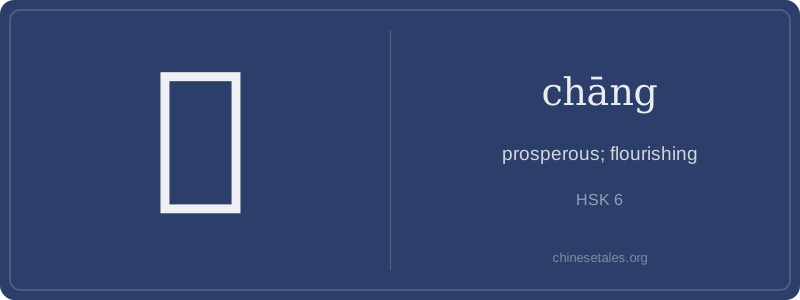
The earliest form of 昌 appears in late Shang oracle bone inscriptions as two stacked 'sun' symbols (☉☉) — not random repetition, but a deliberate doubling of 日 to evoke *radiant, unbroken light*. Imagine ancient scribes carving two suns one above the other: not sunrise and sunset, but *sun upon sun*, symbolizing abundance so great it overflows time itself. Over centuries, the top sun simplified into 日 with a horizontal stroke, and the bottom evolved into a more angular 日 — but crucially, both retained their full structure, preserving the duality. By the Qin small seal script, the character had stabilized into today’s balanced, symmetrical eight-stroke form.
This visual doubling directly shaped its meaning: from 'double brightness' came 'abundant vitality', then 'flourishing state', and finally 'prosperity' in moral and political senses. The Book of Documents (Shūjīng) uses 昌 in '禹錫玄圭,以昭其功;堯曰:「咨!爾舜!天之曆數在爾躬,允執其中。四海困窮,天祿永終。」舜亦以命禹。…帝曰:「來!禹!降水儆予,成允成功,惟汝賢;克勤於邦,克儉於家,不自滿假,惟汝賢。汝惟不矜,天下莫與汝爭能;汝惟不伐,天下莫與汝爭功。予懋乃德,嘉乃丕績,天之曆數在汝躬,汝終有厥位。」禹拜稽首,讓於稷、契暨皋陶。帝曰:「俞!汝往哉!」…禹曰:「…萬邦以乂,庶績咸熙,百工惟時,地平天成,六府三事允治,萬世永賴,時乃功。」 — where '庶績咸熙' implies the collective flourishing that 昌 later crystallized. Its shape *is* its philosophy: harmony through balance, growth through resonance.
Think of 昌 not just as 'prosperous' but as the warm, golden glow of a thriving community — sunlit, rhythmic, and deeply optimistic. Its core feeling is *sustained flourishing*, not just momentary success. You’ll rarely see it alone; it’s almost always paired (like in 兴旺 or 昌盛) to reinforce growth that’s both visible and enduring. Unlike generic positive words like 好 or 美, 昌 carries historical weight — it’s the kind of prosperity Confucius praised in well-governed states, where harvests are abundant *and* people sing together.
Grammatically, 昌 is nearly always an adjective or part of a compound noun — you won’t say 'he is 昌'; instead, you’ll say 国家昌盛 (guójiā chāngshèng, 'the nation is flourishing') or use it in formal, literary, or ceremonial contexts. Learners sometimes mistakenly treat it like a verb ('to prosper'), but it doesn’t conjugate — no 昌了, no 昌过. It’s also never used colloquially: you’d never text '今天超昌!' — that would sound like quoting a Song dynasty edict at your coffee shop.
Culturally, 昌 appears in names of dynasties (e.g., 汉昌), temples, and auspicious phrases during Lunar New Year — but avoid using it for personal praise ('your business is 昌!') unless speaking poetically or ironically. A subtle trap? Its radical 日 (sun/day) hints at brightness and continuity, yet learners often overlook how its doubled 日 visually echoes *repetition → abundance → flourishing*. That symmetry isn’t decorative — it’s semantic architecture.