昏
Character Story & Explanation
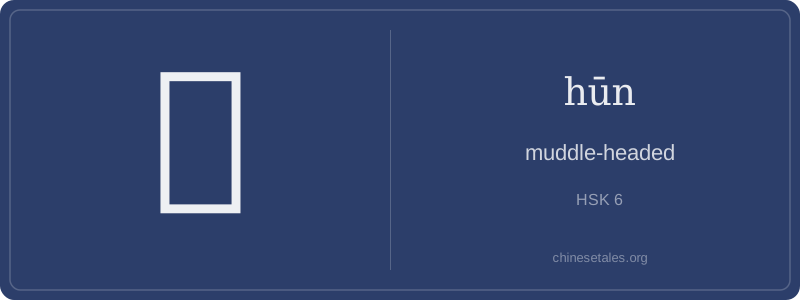
The earliest form of 昏 appears in bronze inscriptions as a sun (日) sinking below a horizontal line representing the horizon — literally ‘sun descending’. Over time, the horizon became the radical 日 (sun/day) at the top, while the lower part evolved from ⺈ (a simplified depiction of descending light) into the modern 千 (qiān) — not the number ‘thousand’, but a phonetic component borrowed for its sound, not its meaning. The eight strokes crystallized by the Han dynasty: two horizontal strokes for the sun’s rim, then the descending stroke of ⺈, followed by 千’s three strokes (丿一十) — all flowing downward, visually echoing sunset’s fade.
This pictorial origin directly birthed its meaning: ‘dusk’ was the first sense (as in 昏礼 hūn lǐ — ‘wedding ceremony’, held at dusk per Zhou rites). From temporal dimness came metaphorical dimness — mental obscurity. By the Warring States period, Zhuangzi used 昏 to describe the sage’s deliberate ‘clouding’ of ego: ‘The perfect man has no self; the spiritual man has no achievement; the sage has no name — his mind is 昏.’ Here, 昏 wasn’t deficiency but transcendence — a beautiful twist where darkness becomes wisdom’s vessel.
Imagine you’re in a Beijing teahouse at dusk—sunlight fading, lanterns flickering, and your friend suddenly slumps slightly, eyes glazed, mumbling about ‘that one meeting… with the spreadsheet… or was it the budget report?’ That dazed, foggy, mentally overloaded state? That’s 昏 (hūn) — not just ‘dizzy’ or ‘tired’, but specifically *cognitive fog*: a mind dimmed like a lamp under thick smoke. It’s visceral, slightly poetic, and rarely used for physical fainting (that’s 晕 yùn). Native speakers reach for 昏 when describing mental exhaustion, confusion after shock, or even philosophical disorientation — think Confucius sighing, ‘The Way is obscured; the age is 昏!’
Grammatically, 昏 behaves like an adjective but packs rhetorical weight. You’ll see it in fixed expressions (昏头昏脑 hūn tóu hūn nǎo — ‘muddle-headed’), as a stative verb (他昏了 tā hūn le — ‘He’s gone mentally blank’), or in literary compounds like 昏聩 (hūn kuì — ‘obtuse, senile’). Crucially, it’s almost never used alone as a standalone verb meaning ‘to faint’ — that’s a classic learner trap. Saying ‘我昏了’ sounds archaic or overly dramatic unless you’re quoting classical poetry.
Culturally, 昏 carries moral gravity: in pre-modern texts, a ‘昏君’ (hūn jūn) isn’t just incompetent — he’s *morally clouded*, his judgment obscured like twilight obscuring paths. Modern usage softens this, but the nuance remains: calling someone 昏 is less about IQ and more about a temporary (or chronic) failure of clarity and responsibility. Learners often overuse it like ‘confused’ — but native speakers reserve it for moments where fog feels *existential*, not merely inconvenient.