昼
Character Story & Explanation
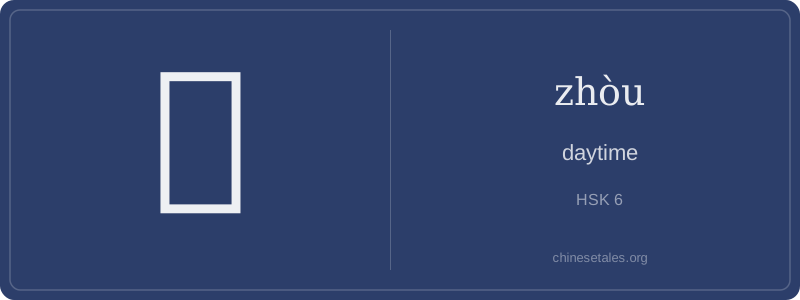
The earliest form of 昼 appears in bronze inscriptions as a stylized combination: the radical 尸 (shī, originally a pictograph of a person crouching, later generalized as ‘corpse’ or ‘cover’) over 日 (rì, ‘sun’). But here’s the twist — 尸 wasn’t meant literally. In ancient script, it represented a *roof-like shelter or canopy*, and 日 beneath it symbolized the sun shining *under open sky during daylight hours* — not at dawn or dusk, but at full, unobstructed noon. Over centuries, the top simplified from a curved roof-shape into today’s 尸, while 日 retained its square sun shape, resulting in the clean, balanced 9-stroke structure we write now.
This visual logic persisted into meaning: 昼 didn’t mean ‘all daylight’, but specifically *the sunlit period when human activity flourished under clear skies* — hence its prominence in classical texts like the *Zuo Zhuan*, where ‘昼会’ (zhòu huì) meant ‘a daytime assembly’ (contrasted with secret nighttime meetings). Even in Tang poetry, 昼 evokes clarity and order: Li Bai wrote of ‘昼锦堂’ — a hall whose splendor was only fully revealed in daylight. The character thus encodes an ancient ecological awareness: light isn’t just physics — it’s the condition for civilization itself.
At its core, 昼 (zhòu) isn’t just ‘daytime’ — it’s the *bright, active, socially sanctioned half of the day*, sharply contrasted with 夜 (yè, night). Think of it as the realm of work, ritual, and visibility: Confucius said ‘昼居于内,夜居于外’ (by day one dwells inside, by night outside) — revealing how deeply time was tied to moral conduct. Unlike the neutral, all-encompassing 日 (rì, ‘sun/day’), 昼 carries a rhythmic, almost institutional weight.
Grammatically, 昼 is a noun but rarely stands alone in speech — you’ll almost always see it in compounds (e.g., 昼夜, 白昼) or literary/compound adverbial phrases like 昼间 (zhòu jiān, ‘during the day’) or 昼伏夜出 (zhòu fú yè chū, ‘active by night, dormant by day’). Learners often mistakenly use it like English ‘daytime’ in casual speech (e.g., *‘I sleep 昼’*), but native speakers would say 白天 (bái tiān) — 昼 feels formal, poetic, or technical (e.g., medical shift schedules: 昼班 zhòu bān).
Culturally, 昼 embodies classical China’s cosmic duality: yin-yang, light-dark, public-private. It appears in idioms like 马不停蹄、昼行夜宿 (mǎ bù tíng tí, zhòu xíng yè sù — ‘horse never stops; travel by day, lodge by night’), evoking urgency and discipline. A common pitfall? Overusing 昼 where 白天 or 日 would sound more natural — it’s not wrong, but it flags your speech as textbook-learned rather than lived-in.