晤
Character Story & Explanation
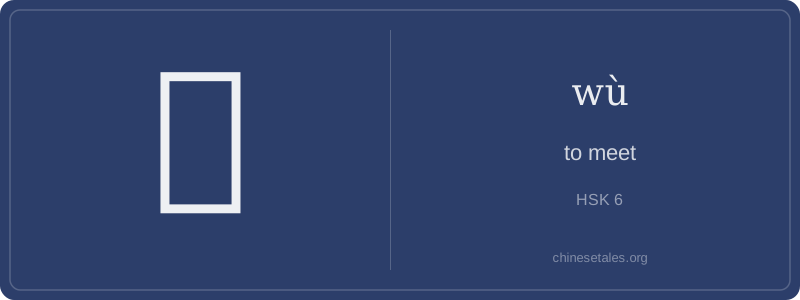
The earliest form of 晤 appears in bronze inscriptions as a compound pictograph: on the left, a simplified sun (日), and on the right, a stylized figure with arms raised — likely representing a person standing upright in daylight, face-to-face, ready to engage. Over centuries, the figure evolved: the arms became 五 (wǔ, 'five'), serving both as a phonetic hint (wù and wǔ share historical sound links) and a visual echo of symmetry — two people, five fingers extended in greeting, or perhaps even the five cardinal directions converging at a meeting point. By the Han dynasty seal script, the right side had stabilized as 亐 — a variant of 五 — and the modern clerical form solidified the clean, balanced structure we see today: 日 + 亐, eleven strokes total, radiating calm authority.
This character wasn’t just about physical presence — it embodied *reciprocal recognition*. In the Zuo Zhuan, 晤 describes diplomatic encounters where lords ‘see each other’s sincerity by daylight’ — hence the 日 radical anchoring truth in visibility. Later, in Tang poetry and Ming letters, 晤 gained emotional depth: Du Fu wrote of ‘晤君如晤春’ (meeting you is like meeting spring), blending warmth with ritual gravity. Even today, 晤 retains that dual resonance: a meeting conducted under open skies — literal, ethical, and literary.
At first glance, 晤 (wù) feels like a quiet, elegant cousin of more common 'meet' verbs like 见 (jiàn) or 会 (huì). But don’t be fooled — this character carries the weight of intentionality and formality. It doesn’t mean casual bumping into someone; it’s for arranged, purposeful meetings — especially in writing, official contexts, or literary registers. Think: a diplomat’s scheduled audience, a scholar’s scholarly exchange, or your boss’s ‘let’s 晤一下’ before a big decision. It’s almost always transitive (you 晤 someone), and rarely appears in spoken colloquial speech — which is why learners often overuse it in everyday chat (‘我昨天晤了朋友’ sounds stiff or archaic).
Grammatically, 晤 is a verb that pairs beautifully with formal time markers and honorifics: 专程晤见 (zhuān chéng wù jiàn — 'meet in person with special intent'), or 晤谈 (wù tán — 'hold a substantive discussion'). It’s never used in progressive aspect (*我在晤他) or with aspect particles like 了 (*晤了) unless embedded in a literary or bureaucratic construction. You’ll see it most often in written reports, meeting minutes, diplomatic cables, or classical-style essays — not in WeChat messages.
Culturally, 晤 subtly echoes Confucian ideals of respectful, purpose-driven human connection: the meeting isn’t incidental — it’s a moral act, an exchange of sincerity under the light of day (hence the 日 radical). A classic mistake? Swapping it with 误 (wù, 'mistake') — homophone danger! Also, learners sometimes write it with the wrong right-hand component (e.g., confusing 亐 with 五), but remember: the top is 五 (wǔ), not 伍 or 吾. That ‘five’ shape isn’t random — it’s part of the ancient phonetic clue!