晶
Character Story & Explanation
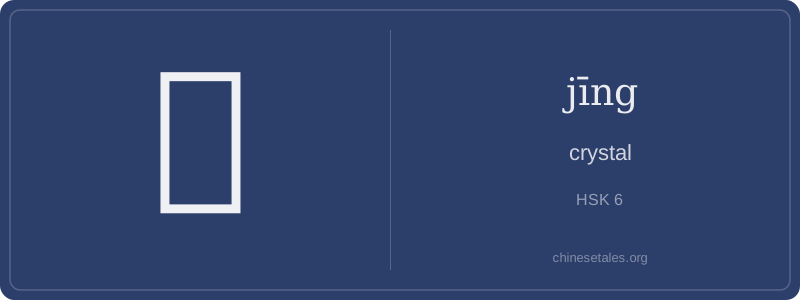
The earliest form of 晶 appears in oracle bone inscriptions as three small, distinct circles — not suns yet, but stylized depictions of *stars* twinkling in the night sky. Each circle represented a luminous point; their triple repetition was ancient shorthand for ‘many bright things’. Over centuries, those circles evolved into the square, structured 日 (rì, ‘sun’) — a natural semantic upgrade since both stars and suns emit light, and 日 was already a stable, high-frequency radical. By the seal script era, the three 日 were neatly stacked in a vertical column, and in clerical script, they flattened slightly, gaining clean horizontal strokes — culminating in today’s balanced, symmetrical 晶: three identical 日, side by side, radiating visual harmony.
This stellar origin explains why 晶 never meant ‘rock’ or ‘mineral’ first — it meant *brightness*, *clarity*, *radiance*. Only later, during the Han dynasty, did its meaning narrow to ‘crystal’ — because clear quartz *looks* like frozen starlight: transparent, refractive, and dazzling. In the Shuōwén Jiězì (121 CE), Xu Shen defined it as ‘bright, luminous — like many suns’, confirming its core idea wasn’t material but optical. Even today, 晶莹 (jīngyíng) describes the sheen of a polished sword or the clarity of a child’s eyes — proving the character’s soul remains celestial, not geological.
At its heart, 晶 (jīng) isn’t just ‘crystal’ — it’s *luminous clarity*: the sharp sparkle of light refracting through pure quartz, the gleam of dew on morning grass, or even the radiant brightness of a star. Its triple-日 (rì, ‘sun’) structure isn’t decorative; it’s emphatic — like saying ‘sun-sun-sun!’ to convey intense, multiplied brightness. In classical and modern Chinese, 晶 functions almost exclusively as a noun or adjective root in compounds (e.g., 水晶 ‘rock crystal’, 晶莹 ‘glistening’); you’ll almost never see it standing alone in speech — unlike English ‘crystal’, which can be a verb (*to crystalize*) or countable noun. Learners sometimes try to use it solo like ‘a crystal’, but that feels unnatural — native speakers say 一颗水晶 (yī kē shuǐjīng), not *一颗晶.*
Grammatically, 晶 shines brightest in descriptive compounds: 晶莹 (jīngyíng) means ‘sparkling-clear’ (often for tears, ice, or water), while 晶体 (jīngtǐ) is the scientific term for ‘crystal’ (as in solid-state physics). Note the tone shift: jīng + yíng, not jīng + jīng — this reflects how the character rarely repeats itself phonetically in real usage. Also beware: 晶 sounds identical to 经 (jīng, ‘classic’/‘to pass through’) and 惊 (jīng, ‘to startle’), so context is everything — mispronouncing 水晶 as *shuǐjīng* with the wrong tone or tone sandhi could leave your listener blinking like a startled deer.
Culturally, 晶 carries poetic weight — Li Bai used 晶荧 (jīngyíng) to describe moonlight on frost, and today it appears in brand names (e.g., 晶晨 ‘Crystal Dawn’ for skincare) to evoke purity and radiance. A common learner trap? Assuming all ‘-jīng’ words relate to crystals — but 晶 is only the *visual-brightness* component; it doesn’t mean ‘essence’ (that’s 精 jīng) or ‘experience’ (that’s 经 jīng). Think of 晶 as the *glint*, not the *gist*.