晾
Character Story & Explanation
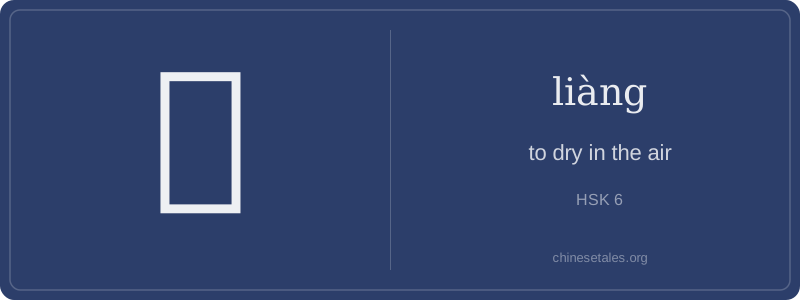
The earliest form of 晾 appears in late Warring States bamboo slips — not as a pictograph, but as a phono-semantic compound: 日 (rì, sun) on the left, and 京 (jīng) on the right. 京 originally depicted a tall watchtower (冂 + 小 + 口), symbolizing height and visibility — crucial for effective air-drying. Over centuries, the top of 京 simplified from three strokes to two horizontal lines, and the lower part condensed into the modern 亠+口+小 shape. Crucially, the ‘sun’ radical wasn’t just decorative: it anchored the meaning in solar exposure, distinguishing it from indoor drying methods.
By the Han dynasty, 晾 appeared in agricultural manuals like the *Fan Shengzhi Shu*, advising farmers to 晾 seed grains before storage to prevent mold. In Tang poetry, it gained poetic resonance — Bai Juyi wrote of ‘晾药’ (liàng yào, airing medicinal herbs) as an act of quiet care. The character never lost its physicality: even today, its 12 strokes visually echo a clothesline — the 日 radical as the sun overhead, the 京 component as poles and draped fabric (the two horizontals = lines, the vertical stroke = a hanging garment). This isn’t abstract — it’s etymology you can hang your laundry on.
At its heart, 晾 (liàng) is the quiet, patient act of letting things breathe in sunlight — clothes flapping on a line, tea leaves spread on bamboo trays, or winter-cured sausages hanging from eaves. It’s not just ‘to dry’; it’s to air-dry *intentionally*, often for preservation, freshness, or ritual purification (think Buddhist robes aired after washing). Unlike generic drying verbs like 干 (gān) or 烘 (hōng), 晾 implies exposure to open air and natural elements — no machines, no heat sources.
Grammatically, 晾 is a transitive verb that almost always takes a concrete object: you 晾衣服 (liàng yīfu), 晾被子 (liàng bèizi), or 晾茶 (liàng chá). It rarely stands alone — you won’t say ‘I’m晾ing’ without specifying *what*. Also, it’s frequently used in serial verb constructions: 她洗完衣服就晾在阳台上 (Tā xǐ wán yīfu jiù liàng zài yángtái shàng) — ‘After washing clothes, she hung them out to dry on the balcony.’ Note the obligatory location phrase (on the balcony) — omitting it sounds incomplete to native ears.
Culturally, 晾 carries subtle class and regional textures: in northern China, 晾被子 is a daily winter ritual against damp cold; in Fujian, 晾鱼干 signals seasonal fishing cycles. Learners often mistakenly use 晾 for oven-drying or towel-dabbing — but those are 烘 or 擦. Also, confusing 晾 with 亮 (liàng, ‘bright’) is common: same sound, same radical, but 亮 has no ‘drying’ connotation — it’s purely about light or clarity. The key is remembering: 日 (sun) + 京 (a phonetic *and* semantic hint — ancient 京 meant ‘high place,’ evoking clotheslines raised into sunlight).