曝
Character Story & Explanation
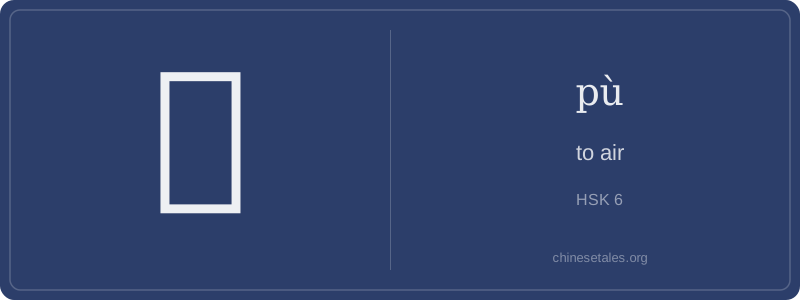
The earliest form of 曝 appears in bronze inscriptions as a composite: 日 (sun) above a simplified figure of a person (人) holding something — possibly grain or cloth — stretched out beneath it. Over centuries, the person evolved into the radical 攵 (‘tap’ or ‘strike’, implying action), while the lower right component solidified into 曲 (qū, 'bent'), suggesting something laid flat and curved under solar heat. By the Han dynasty clerical script, the structure stabilized: 日 on top, then 布 (bù, 'cloth') — phonetic and semantic — fused with 攵 below, yielding today’s 19-stroke form: sun + cloth + deliberate action = intentional exposure to light.
This visual logic held firm across dynasties. In the Qimin Yaoshu (540 CE agricultural manual), 曝 describes drying silkworm cocoons and fermented soybeans — always with precision and timing. Its meaning never strayed from physical sun-exposure until the 20th century, when journalists began using 曝光 metaphorically: 'sunlight revealing hidden facts'. The character didn’t change — society just realized truth, like tofu skins, needs time and light to surface.
Think of 曝 (pù) as Chinese ‘sun-drying’ — not just laundry on a line, but the deliberate, almost ceremonial exposure of something to light and air: herbs on rooftops, soy sauce in clay jars, or even your private photos online. Unlike English 'air', which feels passive, 曝 carries intention and duration — you *choose* to expose, and the sun does the work. It’s rarely used alone; it’s the engine inside compound verbs like 曝光 (bào guāng, 'to expose' — literally 'sun-light') or 曝晒 (pù shài, 'to sun-dry').
Grammatically, 曝 is almost always a verb stem requiring a complement: 曝干 (pù gān, 'dry by sun'), 曝裂 (pù liè, 'crack from sun exposure'). Crucially, it’s *not* the same as 晒 (shài), though both mean 'to sun-dry'. 曝 is formal, literary, and implies intensity or consequence; 晒 is colloquial and neutral. Learners often misread 曝 as bào (like in 曝光), but that’s only when it’s part of the compound — standalone 曝 is *always* pù.
Culturally, 曝 evokes ancient food preservation and medicinal preparation — a slow, trust-in-nature process. Today, its metaphorical leap into digital life ('to expose scandal online') feels jarring yet perfect: sunlight reveals truth, just as viral posts strip away concealment. A common mistake? Using 曝 where 晒 fits better — saying *pù zhào* instead of *shài zhào* for 'posting a photo' makes you sound like a Ming dynasty apothecary announcing a new herbal remedy.