朽
Character Story & Explanation
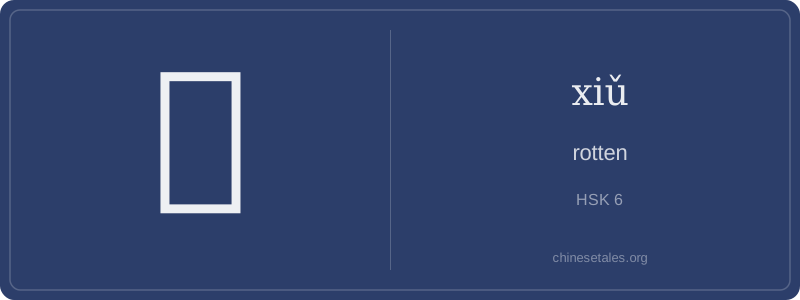
The earliest form of 朽 appears on Warring States bamboo slips as a compound: left side 木 (tree/wood), right side 丣 (yǒu)—an ancient variant of 有 (to have), used here phonetically but originally picturing a wine vessel in a cellar. Over centuries, 丣 simplified into 丂 (a bent stroke representing something twisted or weakened), then further stylized into the modern 右 upper component. The six strokes you write today—wood radical + that compact, slightly sagging right-hand shape—visually echo decay: the vertical 木 stands firm, while the top-heavy, off-center 右 seems to slump, as if the wood is losing its integrity from within.
This visual slumping mirrors its semantic journey: from concrete ‘wood rotting’ in early texts like the *Book of Documents*, it expanded metaphorically by the Han dynasty to describe moral or institutional decay (e.g., 腐朽的制度). Mencius used 朽 in a famous rebuke: ‘A ruler who abandons his people is already 朽’—not physically decomposing, but morally hollowed out. The character thus became a quiet ethical thermometer: when society or character is 朽, the rot isn’t surface-level; it’s structural, silent, and deeply consequential.
At its core, 朽 isn’t just ‘rotten’ in a biological sense—it’s a philosophical sigh. In Chinese, it evokes impermanence, quiet decay, and the gentle but inevitable surrender of matter to time. Think less moldy fruit and more weathered temple beams or ancient bamboo slips crumbling at the edges: it’s decay with dignity, often carrying melancholy beauty rather than disgust. That’s why you’ll rarely hear it in casual complaints ('This apple is 朽!')—it’s too literary, too heavy for grocery talk.
Grammatically, 朽 functions almost exclusively as an adjective or verb in formal or classical constructions. You won’t find it predicatively like ‘This wood is 朽’ (that would sound archaic); instead, it appears in compounds (e.g., 不朽, 腐朽) or in fixed expressions like 朽木不可雕也 (‘Rotten wood cannot be carved’—a Confucian idiom about unteachable people). It also appears in passive-like structures: 书稿已朽 (‘The manuscript has rotted’), where 朽 acts as an intransitive verb indicating completed, irreversible change.
Culturally, 朽 reflects a deep-rooted Daoist-Buddhist sensibility: decay isn’t failure—it’s nature’s quiet logic. Learners often mistakenly use it as a direct synonym for 坏 (‘broken’) or 烂 (‘spoiled’), but 朽 implies structural disintegration over time, not sudden damage. Also, beware tone confusion: xiǔ (third tone) is easily mispronounced as xiū (first tone, ‘to cultivate’) — saying ‘I want to cultivate this wood’ instead of ‘this wood is rotten’ could spark a very confused carpenter.