杆
Character Story & Explanation
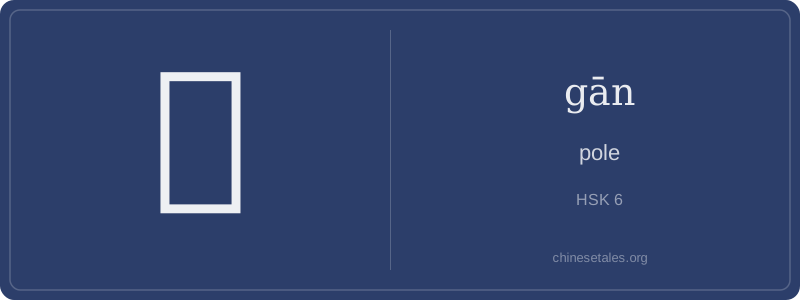
The earliest forms of 杆 appear in bronze inscriptions as a simple vertical line (丨) with a short horizontal stroke near the top — a stylized depiction of a tall, straight wooden staff planted firmly in the ground. Over time, the ‘wood’ radical 木 was added to the left to emphasize material origin, while the right side evolved from 干 (originally a pictograph of a drying rack or upright post) into its modern simplified shape. By the Han dynasty, the seven-stroke structure was standardized: four strokes for 木, three for 干 — clean, balanced, and unyielding, just like the object it names.
This character’s meaning stayed remarkably consistent across millennia. In the *Zuo Zhuan*, rulers raised 杆 to signal assembly; in Tang poetry, fishers cast lines from riverbank 杆; even today’s CCTV surveillance poles (监控杆 jiān kòng gān) inherit that same sense of vertical vigilance. Its visual simplicity — two strong verticals (the 木 trunk and the central stroke of 干) — mirrors its semantic core: stability through upright structure. No flourish, no curve — just wood + purposeful shaft.
At its heart, 杆 (gān) is a sturdy, upright thing — a pole, rod, or shaft. The left side 木 (mù) is the 'tree' radical, instantly telling you this object is made of wood (historically true for most poles: flagpoles, fishing rods, oars). The right side 干 (gān) isn’t just phonetic — it’s a clever semantic echo: 干 means 'dry', 'to do', but crucially, in ancient usage, it also meant 'a vertical staff used in ritual or measurement'. So 杆 isn’t just *any* stick — it’s a purpose-built, functional, often ceremonial or structural vertical element.
Grammatically, 杆 appears mostly as a noun, but watch out: it’s frequently part of compound nouns and rarely stands alone. You’ll see it in measure words like 一杆枪 (yī gǎn qiāng — 'one rifle'), where the reading shifts to gǎn — a classic HSK 6 trap! That alternate pronunciation (gǎn) only appears in fixed measure-word contexts or dialectal usages; otherwise, it’s consistently gān. Learners often misread 杆 as gǎn everywhere, or confuse it with 干 (gān/gàn), missing the wooden essence entirely.
Culturally, 杆 carries quiet authority: flagpoles (旗杆 qí gān), diving boards (跳水杆 tiào shuǐ gān), even the 'pole' in pole vaulting (撑杆跳 chēng gān tiào) all rely on 杆’s connotations of rigidity, length, and controlled extension. It’s never flimsy — think bamboo pole, not twig. A common error? Using 杆 for 'stick' generically (like a candy cane); that’s 棍 (gùn) or 棒 (bàng). 杆 implies function, alignment, and load-bearing form.