杖
Character Story & Explanation
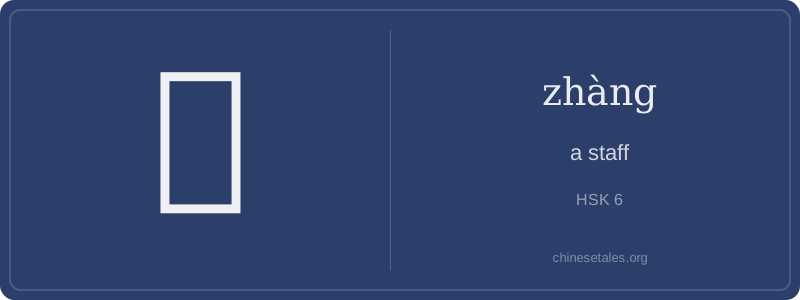
The earliest form of 杖 appears in bronze inscriptions as a simple pictograph: a vertical line (representing the staff) with a hand (又) gripping it at the top — later stylized into the modern left-hand 木 (wood) radical and right-hand 丈 (zhàng, 'measure' or 'adult man'). The 木 radical anchors its material identity — it must be wooden — while 丈 evolved from a glyph depicting a standing man with outstretched arms (a measure of human scale), subtly reinforcing that this is a *human-scale tool*, not a weapon or mere branch. Over centuries, the hand vanished, and 丈 became phonetic — but its original sense of 'adult authority' clung to the character.
This duality shaped its semantic journey: from a practical walking aid in the *Shijing* (Book of Odes), it gained ritual gravity — Confucius praised the 'elder who walks with a staff' as embodying virtue. By the Han dynasty, imperial courts awarded jade- or ivory-tipped 杖 to centenarians as tokens of state honor. Even today, the phrase 拄杖而行 (zhǔ zhàng ér xíng) — 'walking leaning on a staff' — evokes not frailty, but venerable composure. Its visual simplicity (just 7 strokes!) masks layers of social meaning — a wooden rod that holds up both bodies and hierarchies.
Think of 杖 (zhàng) not as a generic 'stick' but as the Chinese equivalent of a ceremonial bishop’s crozier or a Tolkien-style wizard’s staff — an object charged with authority, age, and quiet power. In Chinese, it’s never just wood; it’s dignity made tangible: a walking aid for elders (拄杖), a symbol of official rank (玉杖), or even a tool of discipline (杖刑). Unlike English 'staff', which can mean a group of people, 杖 *only* means a physical rod — and almost always one imbued with cultural weight.
Grammatically, 杖 is a noun that rarely stands alone. You’ll almost always see it in compounds or after verbs like 拄 (to lean on), 执 (to hold), or 受 (to receive, as in punishment). Learners often mistakenly use it like English 'stick' — saying *'tā yòng yī gēn zhàng'* (he uses a staff) — but native speakers say *'tā zhǔ zhe yī gēn zhàng'* (he leans on a staff), emphasizing action and relationship. It also appears in set phrases like 杖朝之年 (zhàng cháo zhī nián), meaning 'the age of 80', literally 'the year one receives the imperial staff' — a Confucian honorific.
Culturally, the staff is a subtle status marker: in classical poetry, a sage’s bamboo 杖 signals reclusion and wisdom; in legal texts, it’s the instrument of corporal punishment. A common mistake? Using 杖 where 棍 (gùn, blunt club) or 棒 (bàng, stick) would fit — but those lack reverence. 杖 implies respect, ritual, or consequence. Forget 'stick'; think 'scepter with seniority.'