械
Character Story & Explanation
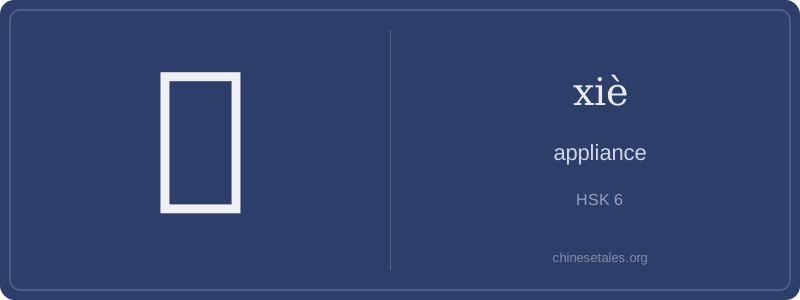
The earliest form of 械 appears in Warring States bamboo slips — not as a pictograph, but as a phonosemantic compound already fully formed: left side 木 (mù, 'tree/wood'), right side 戒 (jiè, 'to warn, guard'). The wood radical signals material origin — many early devices (levers, pulleys, crossbow triggers) were wooden; 戒 provides both sound (ancient pronunciation closer to *kəps*, evolving into xiè) and meaning — devices were made to *guard*, *control*, or *enforce*. Over time, the 戒 component simplified: its top double vertical strokes (⿱丨丨) merged into a single stroke, and the lower 'hand holding a spear' (戈) became abstracted into the current 戊-like shape — giving us today’s 11-stroke structure.
This duality — wood + control — shaped its semantic journey. In the *Zuo Zhuan*, 械 described siege machinery ('wooden implements for guarding or attacking'); by the Tang dynasty, it broadened to any complex apparatus, including water-lifting wheels and astronomical instruments. Crucially, it never meant 'machine' in the modern industrial sense — that role belongs to 机器 (jīqì). Instead, 械 retained its aura of *purposeful design*: a scalpel is 器械 (qìxiè), not just a tool — it’s calibrated for intervention. Its visual weight — solid, upright, unadorned — mirrors its linguistic role: no frills, all function.
At first glance, 械 (xiè) feels like a quiet, technical word — but don’t let its wooden radical (木) fool you: this character isn’t about trees or furniture. It’s about *human-made tools designed for function*, especially those with mechanical precision or strategic purpose — think 'apparatus', 'device', or even 'weapon' in formal contexts. Unlike generic words like 工具 (gōngjù, 'tool'), 械 carries weight: it implies intentionality, structure, and often institutional use — you’d say 武器装备 (wǔqì zhuāngbèi) for 'armaments', but 械 appears in compound terms like 军械 (jūnxiè, 'military equipment') where the tone is official, precise, and slightly austere.
Grammatically, 械 almost never stands alone — it’s a classic 'bound morpheme'. You’ll nearly always see it in two-character compounds (e.g., 机械, 器械, 军械), and it rarely takes modifiers directly. A common learner mistake is trying to say 'this appliance' as *zhè ge xiè*, but that’s unnatural — instead, use the full compound: 这台医疗器械 (zhè tái yīliáo qìxiè, 'this medical device'). Also, note the tone: xiè is fourth tone — not xīe (which doesn’t exist for this character) — so mispronouncing it can make listeners think you’re saying something else entirely.
Culturally, 械 quietly reflects China’s long tradition of valuing functional craftsmanship over ornamentation. In classical texts, it appears in military treatises (like the *Wujing Zongyao*) referring to siege engines and crossbow mechanisms — tools engineered for effect, not elegance. Modern usage retains that pragmatic gravity: 械 conveys seriousness, even solemnity. That’s why it’s absent from casual tech talk (we say 手机, not *手机械*), but central in law (非法器械, fēifǎ qìxiè, 'illegal devices') or engineering standards.