棉
Character Story & Explanation
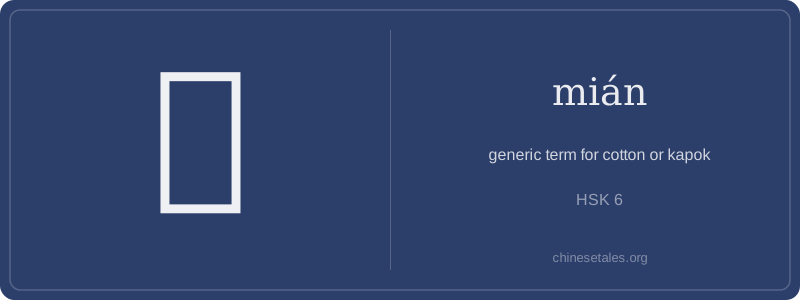
The earliest form of 棉 appears in late Han bamboo slips — not oracle bone or bronze script, because cotton wasn’t cultivated in early China. Its structure is deliberately transparent: left side 木 (mù, ‘tree’), right side 棉’s phonetic component, which evolved from the ancient character 絤 (mián, now obsolete), itself a compound of 糸 (sī, ‘silk thread’) + 宀 (mián, ‘roof’ — here acting phonetically). Over centuries, 絤 simplified and merged with 木 to form today’s 棉: 12 strokes total — 4 for 木, 8 for the right-hand side, visually echoing tangled fibers sprouting from wood.
By the Tang dynasty, 棉 began appearing in agricultural manuals describing kapok trees grown in southern China and Vietnam. But its semantic pivot came in the 13th century: when Mongol rulers promoted cotton farming across north China, 棉 expanded from ‘kapok’ to encompass all soft, fibrous plant down — especially Gossypium. The 木 radical stuck, even though cotton grows on shrubs, not trees — a fascinating case of etymological inertia where the character’s ‘tree’ root reflects its original kapok origin, not botany.
At first glance, 棉 (mián) feels soft and warm — and that’s no accident. Its core meaning isn’t just ‘cotton’ in the botanical sense; it’s the *material essence* of fluffiness, insulation, and gentle resilience. In Classical Chinese, it referred specifically to kapok (the silky fiber from the ceiba tree), not Gossypium cotton — which only entered widespread use in China after the Song dynasty. That historical layer explains why 棉 never appears alone in classical texts: you’ll find it only in compounds like 棉花 (miánhuā, ‘cotton flower’, i.e., the boll), never as a standalone noun for ‘cotton’ like English uses it.
Grammatically, 棉 is almost always a noun modifier — a ‘classifier-like’ attributive noun. You say 棉衣 (miányī, ‘cotton clothing’), not *棉的衣; you say 棉质 (miánzhì, ‘cotton material’), not *棉的质地. Learners often mistakenly treat it like an adjective and insert 的 — a subtle but native-sounding error. Also, note: 棉 is never used for synthetic ‘cotton feel’ fabrics (e.g., polyester blends); for those, Chinese says 棉感 (miángǎn, ‘cotton sensation’) or explicitly names the polymer.
Culturally, 棉 carries quiet weight: during the Ming and Qing dynasties, cotton cultivation transformed rural economies — turning peasant households into textile micro-industries. Today, 棉花 is so deeply embedded in daily life that ‘cotton’ metaphors abound: 棉里藏针 (mián lǐ cáng zhēn, ‘a needle hidden in cotton’) means something deceptively gentle but secretly sharp — a phrase that would baffle learners who think 棉 is just ‘fluffy filler’.