欺
Character Story & Explanation
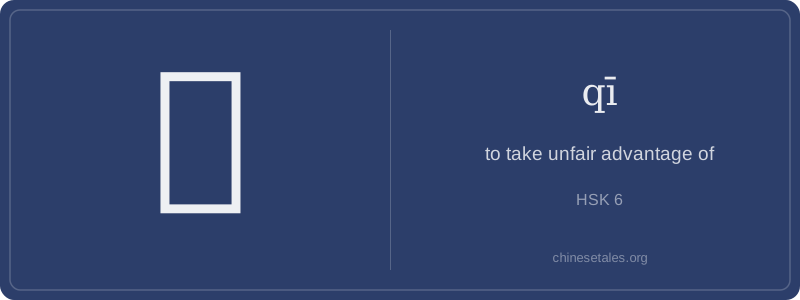
The earliest form of 欺 appears in Warring States bamboo slips: left side was 㐌 (a variant of 其, qí, meaning 'its' or 'that'), acting phonetically, and right side was 欠 — the 'yawning' or 'lacking' radical, hinting at deficiency or insufficiency. Over time, 㐌 evolved into 其 (with its distinctive top stroke and horizontal strokes), while 欠 retained its three-stroke 'open mouth + bent body' shape — suggesting someone *lacking integrity*, their mouth agape not in speech, but in deceitful pretense. By the Han dynasty, the structure solidified: 其 (sound + subtle implication of 'that thing') + 欠 (moral deficit) = a person feigning sincerity while withholding truth.
This visual logic deepened in classical usage: in the *Zuo Zhuan*, 欺 describes rulers who 'promise grain but withhold it' — exploiting dependency. By the Ming dynasty, novels like *Jin Ping Mei* used 欺 to expose hypocrisy in social rituals, where smiling faces concealed contempt. The character’s enduring power lies in that duality: the calm, symmetrical 其 masks the restless, open-mouthed 欠 — a perfect glyph for performative kindness hiding exploitation.
Think of 欺 (qī) as Chinese’s linguistic equivalent of a con artist’s wink — not just lying, but *exploiting trust* with a smirk. It carries moral weight: it’s never neutral like 'deceive' in English; it always implies unfair advantage, often targeting the vulnerable (the elderly, children, or the unsophisticated). You’ll rarely see it alone — it almost always appears in compounds (e.g., 欺骗, 欺诈) or with verbs like 欺负 (to bully) or 欺瞒 (to hoodwink), where the 'unfair power dynamic' is baked into the grammar.
Syntactically, 欺 is almost never used as a standalone verb in modern speech — unlike English 'to cheat', you wouldn’t say *‘He qī me’*. Instead, it appears in tightly bound two-character verbs: 欺负 (qī fu) takes a direct object (*Tā qī fu le wǒ* — 'He bullied me'), while 欺骗 (qī piàn) can be transitive or nominal (*Zhè shì yī chǎng qī piàn* — 'This is a fraud'). Learners who force 欺 as a solo verb sound archaic or poetic — like saying 'forsooth' instead of 'indeed'.
Culturally, 欺 triggers deep Confucian reflexes: it violates xìn (trustworthiness), one of the Five Constant Virtues. That’s why legal documents and anti-fraud campaigns use 欺 so heavily — it’s not just illegal, it’s *morally corrosive*. A common mistake? Using 欺 for simple 'mistake' or 'misunderstanding'; those are wùjiě or chācuò — no moral failing implied. 欺 always means someone *chose* to exploit another’s goodwill.