歹
Character Story & Explanation
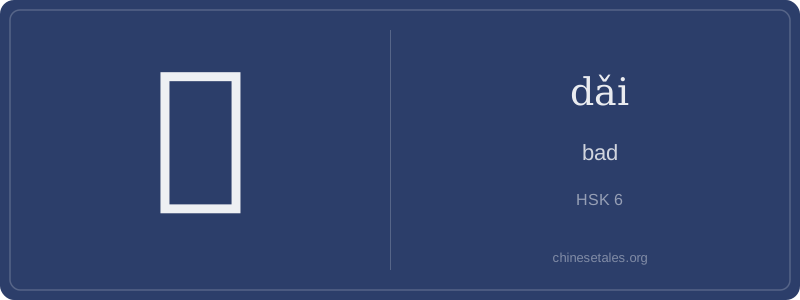
Carved over 3,200 years ago on oracle bones, 歹 began as a stark pictograph of a *skeleton’s exposed ribcage* — three curved strokes representing ribs, with a final downward stroke and dot symbolizing a collapsed sternum or a fatal wound. In bronze inscriptions, it grew more angular but kept its skeletal essence: the first stroke is a slanted ‘falling’ line (like a collapsing spine), the second a sharp inward hook (a bent rib), the third a descending curve (another rib), and the fourth dot — not decorative, but the *last drop of blood* or the point of mortal impact. By the Han dynasty, clerical script smoothed the curves, but the four-stroke austerity remained untouched.
This wasn’t abstract ‘evil’ — it was literal, physical demise. In the *Zuo Zhuan*, 歹 appears in phrases like 歹心 (dǎi xīn, ‘rotten heart’), where the character’s skeletal origin fused with moral decay: a heart so corrupted it resembled bare bone. The visual logic is chillingly direct — if your heart is 歹, it’s already stripped bare, lifeless, and dangerous. That’s why 歹 never softened into colloquial ‘bad’; its form locked in its meaning: not ‘suboptimal’, but *structurally compromised, beyond repair*.
Think of 歹 (dǎi) as Chinese’s ‘villain glyph’ — not just ‘bad’ in the moral sense, but the deep, visceral kind: decay, danger, death-adjacent. Unlike English ‘bad’, which can be casual (*bad hair day*), 歹 carries forensic gravity — it’s the root in words like 歹徒 (dǎi tú, ‘criminal’) and 歹意 (dǎi yì, ‘malicious intent’). It almost never stands alone; you’ll *never* say ‘this food is 歹’ — that’s ungrammatical. Instead, it functions exclusively as a semantic radical or within compound nouns/abstract nouns tied to harm or corruption.
Grammatically, 歹 is a fossilized morpheme: it doesn’t conjugate, isn’t used predicatively, and never appears in verb phrases or adjectival predicates. Learners often mistakenly try to use it like 坏 (huài, ‘bad’) — e.g., *这个计划很歹* — but that’s nonsensical. 歹 only lives inside compounds, where it injects an aura of irrevocable damage or moral rupture. Its presence signals something has crossed a threshold — not just flawed, but *corrupted at the root*.
Culturally, 歹 evokes classical notions of ‘unrectifiable evil’: in Ming dynasty legal texts, 歹人 meant ‘a person beyond redemption’, and in modern usage, 歹 is avoided in speech for euphemism (e.g., saying 意外 ‘accident’ instead of 歹亡 ‘fatal death’). A common error? Confusing it with 夕 (xī, ‘evening’) — same top stroke, but 歹’s final dot is a grim period to life itself.