残
Character Story & Explanation
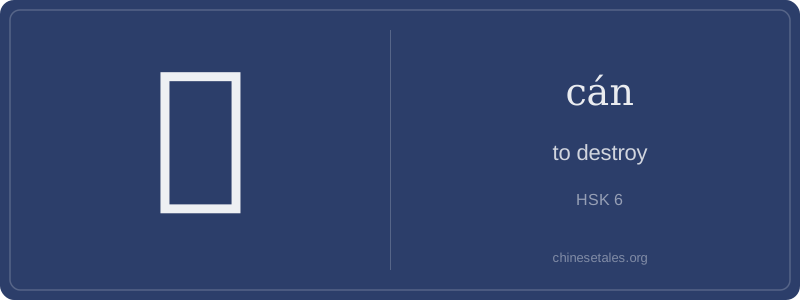
The earliest form of 残 appears in bronze inscriptions as a composite: the radical 歹 (depicting a skeleton or exposed bones, symbolizing death/decay) fused with 戔 (jiān), which originally showed two axes striking downward — a pictograph of repeated, violent cutting. Over time, the top evolved into the simplified 丿 + 戋 structure we see today: nine strokes total — three for the radical 歹 (starting with the dot, then horizontal, then slant), and six for 戔 (two stacked ‘axes’ — each made of 丿 and 一). The visual rhythm is sharp and jagged, mirroring its meaning: no smooth curves, only cuts and fractures.
By the Warring States period, 残 had hardened into its core sense: ‘to maim, mutilate, or reduce to remnants’. In the Zuo Zhuan, it describes armies ‘leaving only殘兵 (cán bīng, “surviving but shattered troops”) after defeat’. Later, in Tang poetry, it gained poetic resonance — Du Fu wrote of ‘残阳如血’ (cán yáng rú xuè, ‘the dying sun like blood’), where 残 doesn’t mean ‘destroyed sun’ but ‘fading, incomplete, poignantly transient’. This duality — physical violence and aesthetic fragility — is encoded right into its strokes: every line feels like a wound that hasn’t yet closed.
Imagine a battlefield at dawn — broken spears, scorched banners, and the lingering smoke of a siege that left only fragments behind. That’s the visceral weight of 残 (cán): not just ‘to destroy’, but to leave something *shattered beyond restoration* — physically, emotionally, or structurally. It carries a sense of irreversible damage, often with moral gravity: 残害 (cán hài) means ‘to brutalize’, not merely ‘hurt’; 残酷 (cán kù) is ‘brutal’, not just ‘harsh’. This character rarely stands alone as a verb — you won’t say ‘I cán the vase’ — but appears in compound verbs (e.g., 摧残, tàn cán), adjectives (残破, cán pò), or nouns (残局, cán jú — ‘a ruined situation’).
Grammatically, 残 almost always functions as a prefix or modifier, never as a standalone transitive verb like 毁 (huǐ) or 破 (pò). Learners mistakenly try to use it like ‘destroy’ in English — ‘He cán the document’ — but native speakers say 他毁掉了文件 (tā huǐ diào le wénjiàn). Instead, 残 appears in set phrases: 残存 (cán cún, ‘to barely survive’), 残余 (cán yú, ‘remnant’), or as part of literary or formal registers — especially in historical, legal, or ethical discourse.
Culturally, 残 evokes Confucian discomfort with incompleteness and violation — think of the Analects’ emphasis on wholeness and ritual integrity. Its radical 歹 (dǎi, ‘death-related’) signals danger from the outset, and its association with disability (残疾人, cán jí rén) reflects an older, now contested, semantic layer: what remains *after* harm. Modern usage increasingly pairs it with compassion — e.g., 残疾人权益 (cán jí rén quányì, ‘disability rights’) — subtly shifting from ‘brokenness’ to ‘dignity amid difference’.