毁
Character Story & Explanation
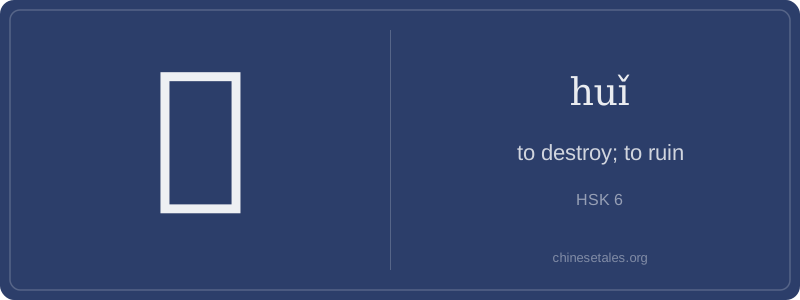
The earliest form of 毁 (found on bronze inscriptions from the Western Zhou) shows two key elements: a hand holding a weapon (the precursor to 殳 shū, 'a polearm') striking downward toward a vessel or container — possibly a ritual bronze cauldron (represented by the top part, later stylized as + 工). That image was stark and literal: a deliberate, forceful act of breaking sacred or valuable objects — perhaps as punishment, ritual dissolution, or wartime plunder. Over centuries, the vessel shape simplified into the top component ( + 工), while the attacking hand-and-weapon fused into the radical 殳 at the bottom.
This visual logic never faded: 毁 retained its core idea of *intentional, forceful dismantling*. In the Classic of Filial Piety, it appears in warnings about how reckless words can 毁 family harmony; in Tang poetry, poets lamented how war could 毁 cities overnight. Even today, the character’s structure whispers its origin — the weapon-like 殳 at the base literally *supports* the act of destruction above it, making the whole character feel like a collapsing monument held up only by the instrument of its own ruin.
At its heart, 毁 (huǐ) isn’t just ‘to destroy’ — it’s the visceral, often irreversible *unmaking* of something that had structure, value, or integrity: a reputation, a treaty, a building, even one’s own health. Unlike generic verbs like 破 (pò, 'to break'), 毁 implies agency, intentionality, and consequence — you don’t ‘accidentally’ 毁 a marriage; you *ruin* it through action or neglect. It carries moral weight, especially in formal or literary contexts.
Grammatically, 毁 is versatile but picky: it’s transitive and almost always requires an object (e.g., 毁掉证据, not just 毁). You’ll see it in resultative compounds like 毁坏 (huǐhuài, 'to damage severely') or passive constructions like 被毁 (bèi huǐ, 'was destroyed'). Watch out — learners often mistakenly use it where English says 'break' (e.g., 'break a promise' → 违背承诺 wéibèi chéngnuò, not 毁承诺!). Also, it rarely stands alone as a verb in speech; you’ll almost always see it with aspect particles (了, 掉, 成) or in compound form.
Culturally, 毁 appears frequently in classical warnings and modern headlines — think of phrases like 毁誉参半 (huǐ yù cān bàn, 'equally praised and criticized') or the legal term 毁谤 (huǐbàng, 'defamation'). A classic learner trap? Confusing 毁 with 灭 (miè, 'to extinguish/annihilate'): 灭 suggests total erasure (like extinguishing fire), while 毁 emphasizes *shattering form* — a statue can be 毁 (shattered into pieces) but still exist materially, whereas 灭 implies nonexistence.