氏
Character Story & Explanation
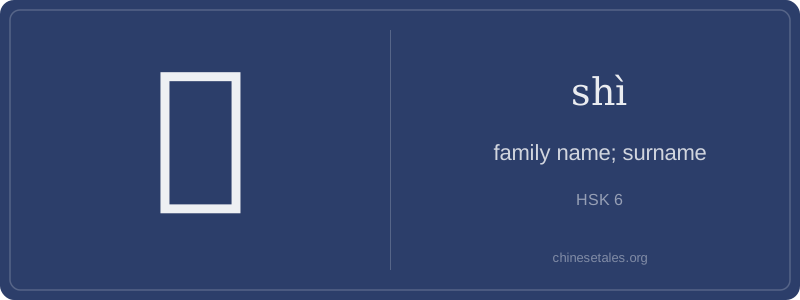
The earliest form of 氏 appears in oracle bone inscriptions as a simple vertical line with a short horizontal stroke near the top — resembling a stylized banner pole planted in earth. That pole wasn’t decorative: it symbolized authority, lineage, and territorial claim. Over time, the bronze script added a subtle curve at the base (evolving into today’s 丶 dot), turning the glyph into a minimalist emblem of rooted identity — four strokes capturing presence, origin, and belonging. By the small seal script era, it stabilized into its current shape: a single downward stroke (丨), a top hook (⺄), a horizontal bar (一), and a final dot (丶) — clean, upright, and quietly authoritative.
This visual austerity mirrors its semantic journey: from a marker of aristocratic branch families (e.g., the Jiānghuá 氏 clan, a cadet line of the Jī 姓) to a respectful honorific suffix in classical texts like the *Zuo Zhuan*, where ‘Qín shì’ denotes ‘the Qin family’, distinguishing them from the broader Ying 姓. Crucially, 氏 was historically gender-flexible — women retained their natal 氏 after marriage, unlike Western surnames — making it a silent testament to early Chinese kinship logic. Its minimalism belies profound social grammar: every stroke is a pillar holding up an entire system of identity.
Imagine you’re at a Ming dynasty banquet, and the host introduces his guest: 'This is Zhū Shì — Master Zhū of the Zhu family.' The word 'Shì' here isn’t just 'surname' — it’s a quiet bow to lineage, status, and ancestral weight. In classical Chinese, 氏 (shì) was used for matrilineal or branch-line surnames — distinct from 姓 (xìng), the ancient, unchanging clan name. Today, 氏 still carries that air of formality and reverence: you’ll see it in historical texts, academic citations (e.g., ‘Darwin shì’), or when respectfully referring to a scholar by their family name alone.
Grammatically, 氏 functions as a noun suffix meaning 'of the X family' or 'the X family', often replacing a personal name in formal writing. It’s never used alone as a standalone noun like 姓; you wouldn’t say *‘wǒ de shì shì Zhāng’ — instead, it appears in compounds like 張氏 (Zhāng shì, 'the Zhang family') or after names in titles: 孔子氏 (Kǒngzǐ shì, 'Master Kong’s family'). Learners often mistakenly treat 氏 as interchangeable with 姓, but doing so strips away centuries of social nuance — think of 氏 as the velvet rope at a royal ball, while 姓 is the guest list itself.
Culturally, 氏 subtly signals hierarchy and distance: using 氏 instead of a given name shows deference without intimacy. In modern usage, it’s rare in casual speech but thrives in legal documents (e.g., 配偶氏, 'spouse’s surname'), genealogical records, and scholarly discourse. A common slip? Adding 氏 after a first name (e.g., *‘Lǐ Xiǎo Míng shì’) — that’s not just awkward, it’s linguistically nonsensical. 氏 always follows the family name — never the given name.