沛
Character Story & Explanation
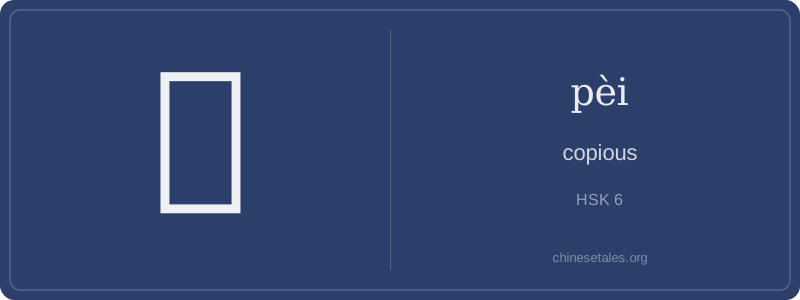
The earliest form of 沛 appears in bronze inscriptions as a combination of 氵 (water) and 市 (shì), but crucially — not the modern ‘market’ character. Rather, it borrowed the shape of an ancient pictograph depicting *a hand holding a bundle of reeds or stalks*, symbolizing lush, dense growth by water. Over centuries, the ‘bundle’ simplified into 市 (which later took on its market meaning separately), while the water radical 氵 remained firmly anchored on the left — a visual promise that this abundance springs from, and flows like, water.
This origin explains why 沛 never means mere ‘quantity’ — it’s inherently *hydrological and organic*. In the Book of Songs (Shījīng), 沛 appears in phrases describing rivers swelling after rain; by the Han dynasty, it extended metaphorically to describe overflowing virtue (e.g., ‘德泽沛然’ — ‘benevolence spreads copiously’). Even today, its strokes — three water dots + four strokes forming 市 — echo that ancient image: water energizing dense, thriving life. No wonder it feels so vital — it literally began as water feeding a flourishing marsh.
At its heart, 沛 (pèi) isn’t just ‘copious’ — it’s the *vibrant fullness* of something alive and flowing: rushing water, surging energy, abundant vitality. It carries a distinctly positive, almost exhilarating connotation — think not just ‘a lot,’ but ‘a lot *in motion*, brimming with life.’ You’ll rarely see it alone; it’s almost always paired in compound words like 沛然 (pèi rán) or 沛然莫御 (pèi rán mò yù), where it intensifies the sense of unstoppable abundance.
Grammatically, 沛 is strictly literary and formal — you won’t hear it in casual speech or texting. It functions as an adjective or adverbial modifier, often preceding verbs or nouns in classical or elevated modern prose. Learners sometimes mistakenly use it like a standalone quantifier (e.g., ‘*pèi shuǐ*’ for ‘copious water’), but that’s unnatural; instead, you’d say 水势沛然 (shuǐ shì pèi rán — ‘the water’s momentum is copious’) or 沛然充沛 (pèi rán chōng pèi — ‘abundantly ample’). Its power lies in pairing — it’s a team player, not a solo act.
Culturally, 沛 reflects a deep Chinese appreciation for *dynamic abundance*: not static stockpiles, but flourishing, circulating vitality — like qi in the body or rain in spring. Confusing it with neutral terms like 多 (duō) misses this energetic nuance. A common learner trap is overusing it in spoken contexts; remember: if your sentence sounds like a Tang dynasty poem or a government white paper, you’re probably on the right track — if it sounds like ordering coffee, you’re not.