沸
Character Story & Explanation
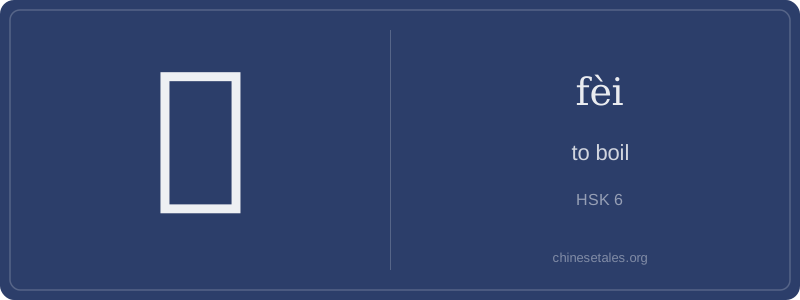
The earliest form of 沸 appears in Warring States bamboo slips as a combination of 水 (water, later simplified to 氵) and 弗 (fú), which originally depicted a bent stick restraining something—like force holding back pressure. In oracle bone script, 弗 showed two crossed lines over a vertical stroke, evoking *resistance overcome*. When paired with water, it visually shouted: 'water under such intense pressure that restraint fails and bubbles burst forth!' Over centuries, 弗’s top strokes softened into the modern 弗 shape (two horizontal lines + a curved hook), while the water radical condensed from three dots to the flowing 氵 we know today—8 clean strokes capturing chaos tamed by structure.
This visual logic endured: in the Classic of Poetry, 沸 described springs gushing violently; by the Tang dynasty, poets like Du Fu used 沸腾 (fèiténg) to depict war drums shaking the earth—linking physical boiling to emotional and societal rupture. Even today, the character’s shape mirrors its meaning: the three water dots surge leftward, while 弗’s downward curve suggests containment collapsing into upward eruption—a perfect kinetic glyph.
At its core, 沸 (fèi) isn’t just about water bubbling—it’s about *intense, visible energy breaking the surface*: think steam erupting, emotions surging, or crowds roaring. The character pulses with kinetic urgency: it’s rarely used for gentle simmering (that’s 煮 or 炖), but for the dramatic moment when heat overcomes resistance and transformation becomes unavoidable.
Grammatically, 沸 is primarily a verb—'to boil'—but it shines in vivid descriptive compounds and metaphorical extensions. You’ll see it in stative constructions like 水开了 (shuǐ kāi le, 'water has boiled'), but more tellingly in literary or formal contexts where it modifies nouns: 沸腾的激情 (fèiténg de jīqíng, 'boiling passion') or 沸反盈天 (fèi fǎn yíng tiān, 'uproar filling the heavens'). Crucially, it’s *not* used as an adjective on its own ('boiling hot' is 滚烫, not *沸热); learners often overextend it like English 'boiling', leading to unnatural phrasing.
Culturally, 沸 carries classical weight: in texts like the Book of Rites, boiling water symbolized ritual purity and readiness; today, its metaphors dominate political and media discourse—'public opinion boils' (舆论沸腾) implies uncontrollable momentum, not just warmth. A common trap? Confusing it with 非 (fēi, 'not') due to similar pronunciation—but the radical 氵 (water) is your anchor: if there’s no water, there’s no boiling.