沼
Character Story & Explanation
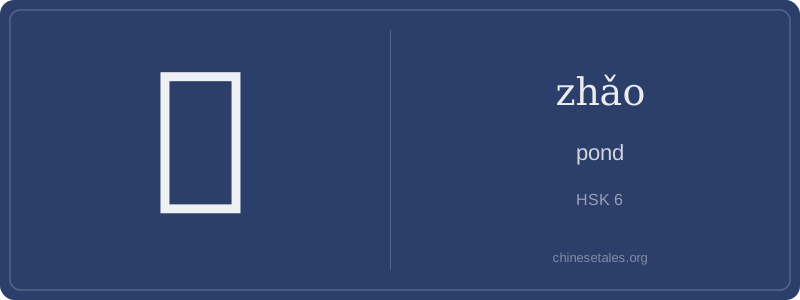
The earliest form of 沼 appears in bronze inscriptions as a flowing water radical (氵) beside a phonetic component 从 (cóng), which itself evolved from two people walking — but here, it was borrowed purely for sound. In oracle bone script, there’s no direct precursor; the character emerged later, during the Warring States period, as a phono-semantic compound: 氵 (water) + 从 (cóng, now read zhǎo) — the latter serving as a 'sound hint' that shifted over centuries. Visually, the three dots of 氵 anchor the left side, while the right side 从 simplifies to 乍 in modern script — eight clean strokes total: three for water, five for the phonetic frame.
By the Han dynasty, 沼 meant specifically 'shallow, stagnant freshwater basin' — distinct from tidal marshes (瀉) or deep lakes (淵). It appears in the Shijing (Book of Odes): '池沼淪漪' — describing ripples in still waters — cementing its association with tranquility and subtle movement. Later, in Ming-Qing garden literature, 沼 became a hallmark of literati aesthetics: not merely functional, but a compositional element — a reflective void amid rocks and plum trees, embodying the principle of 'emptiness giving rise to fullness' (虛實相生).
Think of 沼 (zhǎo) not as just 'pond' — but as a *still, shallow, reed-fringed body of water* with quiet ecological weight. In Chinese, it evokes wetland intimacy: not the grandeur of 湖 (hú, lake) or the flow of 河 (hé, river), but something softer, older, and slightly mysterious — like the mist-shrouded ponds in classical ink paintings or the hidden marshes where poets retreated to write. It’s almost always a noun, rarely used alone; you’ll meet it in compounds like 沼澤 (zhǎozé, marsh) or in poetic or scientific contexts.
Grammatically, 沼 behaves like a concrete, countable noun — but here’s the trap: learners often try to use it like English 'pond' in casual speech ('Let’s go to the pond!'), only to sound oddly literary or archaic. Native speakers say 池塘 (chítáng) for everyday ponds; 沼 feels more like 'fen', 'bog', or 'slough' — precise, slightly technical, and emotionally reserved. You’ll see it in environmental reports ('濕地保護區內有三處天然沼') or Tang poetry ('月照寒沼,鶴影徘徊').
Culturally, 沼 carries Daoist and agrarian echoes: still water symbolizes yin energy, reflection, and hidden life — think of Zhuangzi’s famous line about turtles delighting in muddy swamps (泥沼). A common mistake? Confusing it with 沼 (same character!) — wait, no — that’s the point! Learners mix it up with 沼’s lookalikes (like 沼 vs. 沼? No — see 'similar' below!). The real nuance is tonal: zhǎo is third tone, sharp and dipping — like stepping into cool, unexpected water.